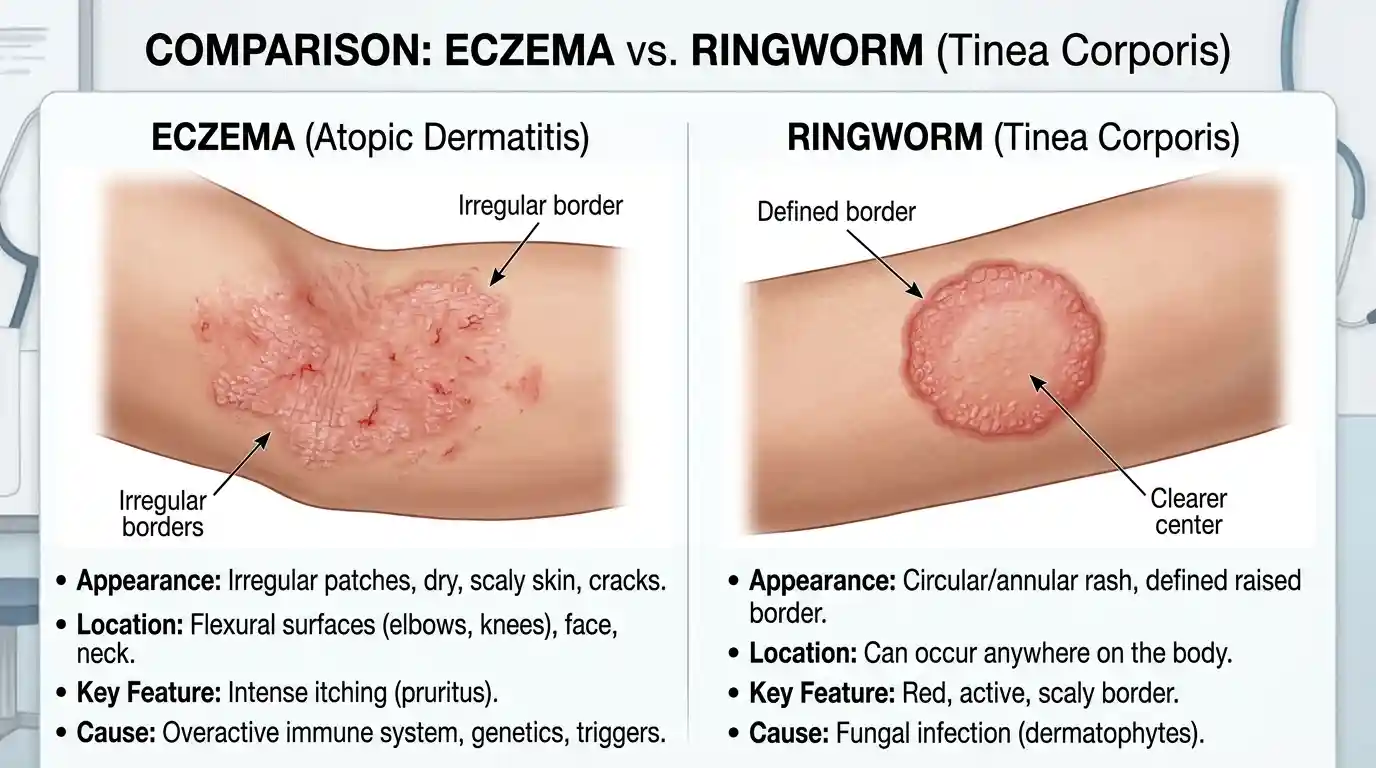
You notice a red, itchy patch on your skin. It won’t go away. Is it eczema? Is it ringworm? You’re not alone in asking. Both conditions cause red, scaly, itchy skin, and both can show up almost anywhere on the body. That overlap is exactly why so many people search “eczema or ringworm” they’re staring at a rash and trying to figure out what it is before they call a doctor.
The confusion makes sense. Eczema and ringworm can look similar at a glance. But they have different causes, spread differently, and need different treatments. Eczema is not contagious. Ringworm is. Using the wrong treatment can make things worse steroid creams for eczema, for example, can actually help ringworm spread.
This article gives you a clear, simple answer: what each condition is, how to spot the differences, and when to see a doctor. It’s written for anyone who wants a fast, honest answer, not a wall of medical jargon.
Eczema or Ringworm Quick Answer
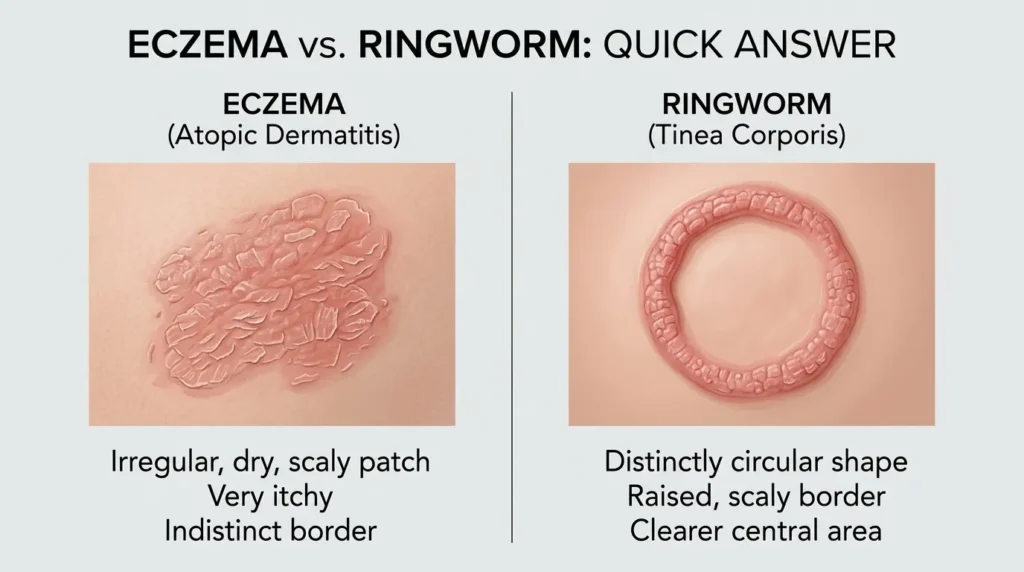
Here’s the short version:
- Eczema is a chronic skin condition. It’s not caused by an infection. It often runs in families and links to allergies or asthma. It causes dry, itchy, inflamed skin, often in the same spots over and over (elbows, knees, hands, face).
- Ringworm is a fungal infection. It’s contagious. It gets its name from its ring-shaped rash, not from an actual worm. It can spread from person to person, from pets, or from contaminated surfaces like gym mats.
Example: A child with dry, cracked skin behind the knees that flares up every winter likely has eczema. A wrestler with a new, coin-shaped red ring on their forearm after practice likely has ringworm.
What Is Eczema?
Eczema (also called atopic dermatitis) is a long-term condition where the skin barrier doesn’t hold moisture well. This lets irritants and allergens in more easily, which triggers inflammation.
Key facts about eczema:
- It’s not an infection. You can’t catch it from someone else.
- It often starts in childhood but can appear at any age.
- It’s linked to genetics, allergies, asthma, and hay fever.
- Common triggers include dry weather, harsh soaps, stress, sweat, and certain fabrics.
- Skin often looks dry, cracked, and thickened over time from scratching.
What Is Ringworm?
Ringworm (tinea) is a fungal skin infection, not a parasite. The name comes from the ring-shaped, raised, scaly border that often forms as the infection spreads outward from a center point.
Key facts about ringworm:
- It’s caused by dermatophyte fungi, which feed on keratin in skin, hair, and nails.
- It’s contagious through skin-to-skin contact, shared towels or clothing, and infected animals.
- It’s more common in warm, humid climates and in people who share close physical contact (like athletes).
- The rash often has a clear or scaly center with a raised, red, active border the classic “ring” look.
- Different names apply depending on location: tinea corporis (body), tinea pedis (athlete’s foot), tinea capitis (scalp), tinea cruris (jock itch).
Eczema vs Ringworm Key Differences
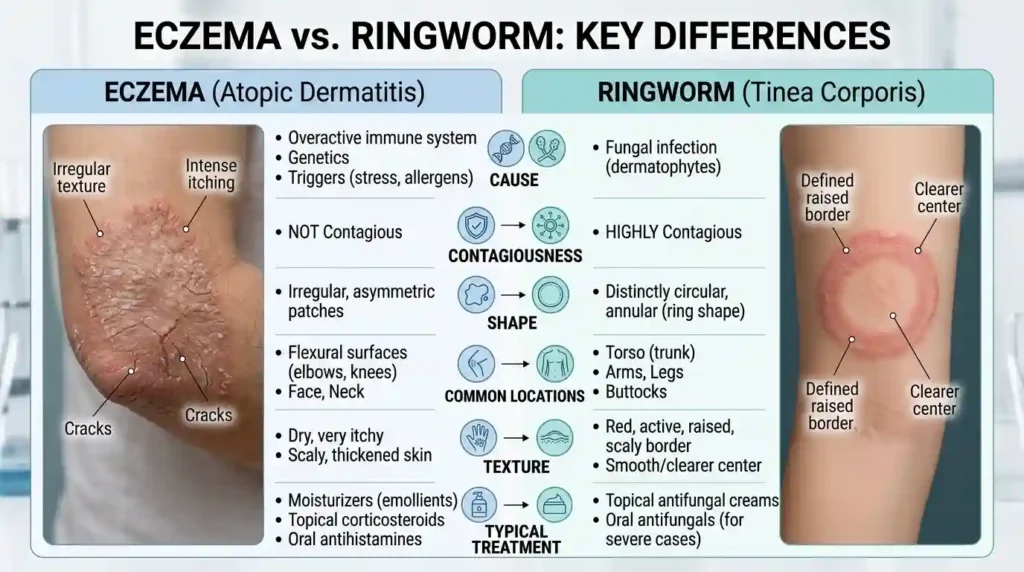
| Feature | Eczema | Ringworm |
| Cause | Skin barrier + immune response | Fungal infection |
| Contagious? | No | Yes |
| Shape | Irregular, patchy | Ring-shaped, defined border |
| Common locations | Elbows, knees, hands, face | Anywhere; scalp, groin, feet common |
| Texture | Dry, cracked, thickened | Scaly edge, sometimes clearer center |
| Linked conditions | Allergies, asthma, hay fever | None; linked to exposure/contact |
| Typical treatment | Moisturizers, steroid creams | Antifungal creams or pills |
| Runs in families? | Often yes | No |
Which One Do You Have?
You can’t diagnose yourself with certainty from a photo or a description, but these patterns can help narrow it down:
- If the rash is ring-shaped with a raised, spreading edge and a calmer center, ringworm is more likely.
- If the rash is patchy, dry, and keeps returning in the same spots (especially with a history of allergies or asthma), eczema is more likely.
- If you recently had close contact with someone with a rash, or with an animal, and then developed a new circular patch, think ringworm first.
- If the itching has been ongoing for years and flares with weather, stress, or certain products, think eczema first.
When in doubt, see a doctor. A quick skin scraping test can confirm ringworm in minutes.
Common Mistakes When Self-Diagnosing
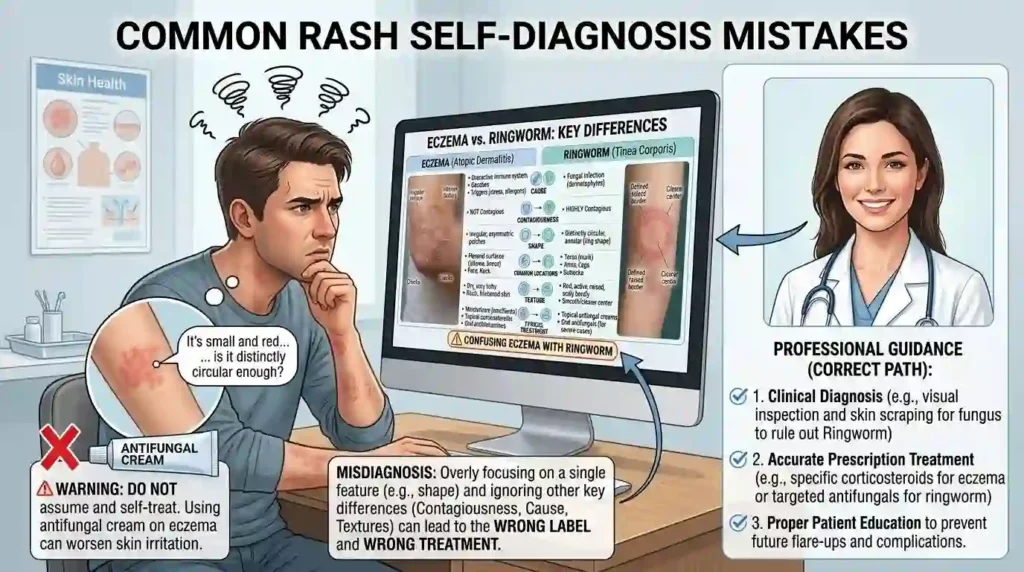
- Using steroid cream on ringworm. Steroids suppress the immune response, which can let the fungus spread further and change the rash’s appearance, making it harder to diagnose (sometimes called “tinea incognito”).
- Assuming any ring shape means ringworm. Some eczema patches and other rashes (like nummular eczema) can also look round.
- Ignoring the contagious risk. People with ringworm keep sharing towels or bedding, unknowingly spreading it to others.
- Waiting too long to get a professional opinion. Both conditions can worsen without proper treatment, and only one needs antifungal medication.
- Confusing the name “ringworm” with a parasite. No worm is involved it’s purely fungal.
Eczema or Ringworm in Everyday Examples
In a text to a friend:
“My son has this ring-shaped rash on his arm, going to the doctor tomorrow worried it’s ringworm from the gym mats.”
In a parenting forum post:
“Is this eczema or ringworm? She’s had dry patches behind her knees since she was two, but this new one on her arm looks different.”
In a news health segment:
Local news reports have covered ringworm outbreaks at gyms and schools, reminding people to wash mats and avoid sharing towels.
In a formal medical intake form:
“Patient presents with pruritic, erythematous lesion; differential diagnosis includes eczema vs. tinea corporis; recommend KOH prep to confirm.”
Eczema or Ringworm Search Trends & Usage
People search “eczema or ringworm” most often when they’ve just noticed a new rash and want a fast comparison before booking a doctor’s visit. Searches for both terms tend to rise during:
- Back-to-school and sports seasons, when ringworm spreads through shared equipment and close contact.
- Winter months, when dry air triggers eczema flare-ups.
- Warm, humid climates, where fungal infections like ringworm are more common year-round.
Parents searching on behalf of children make up a large share of this search, since both conditions are common in kids and easy to mix up at a glance.
Keyword & Term Variations
| Term | What People Usually Mean |
| Eczema or ringworm | Trying to tell the two apart |
| Ringworm vs eczema | Same intent, reversed order |
| Is this eczema or a fungal infection | Same question, broader phrasing |
| Ringworm symptoms | Wants to confirm ringworm specifically |
| Eczema flare-up | Wants to confirm eczema specifically |
| Circular rash not ringworm | Ruling out ringworm for another cause |
FAQs
Can eczema turn into ringworm?
No. They’re unrelated conditions with different causes one isn’t a stage of the other. But eczema-damaged skin can become more vulnerable to picking up a fungal infection like ringworm.
Is ringworm actually caused by a worm?
No. It’s a fungal infection. The name comes from the ring-shaped rash it causes, not from any worm.
Can you have eczema and ringworm at the same time?
Yes. Having one doesn’t protect you from the other, and eczema-prone skin can sometimes be more susceptible to fungal infections.
How long does ringworm take to clear up?
With antifungal treatment, mild ringworm often clears in 2 to 4 weeks. Scalp or nail infections can take longer and may need prescription medication.
Does eczema ever go away completely?
For some people, especially children, eczema improves significantly or resolves with age. For others, it’s a lifelong condition managed with skincare and avoiding triggers.
How can a doctor tell them apart for certain?
A doctor can often diagnose visually, but a KOH skin scraping test checks for fungal cells under a microscope, confirming or ruling out ringworm.
Is ringworm dangerous?
Ringworm is usually not serious and responds well to treatment, but it should be treated promptly since it’s contagious and can spread to other body parts or other people.
Conclusion
Eczema and ringworm can look alike, but they are not the same thing, and mixing them up matters. Eczema is a chronic, non-contagious condition tied to skin barrier and immune response. Ringworm is a contagious fungal infection that needs antifungal treatment, not steroid cream.
The fastest way to tell them apart is to look at the shape and history: a ring-shaped, spreading rash with a raised border points to ringworm, especially after contact with an infected person, animal, or shared surface. A dry, patchy rash that keeps returning in the same spots, especially with a history of allergies, points to eczema.
Self-diagnosis is a useful starting point, but it isn’t a substitute for a medical opinion especially since treating ringworm with the wrong product can make it worse. If you’re unsure, a quick visit to a doctor or dermatologist can confirm the cause in minutes and get you on the right treatment fast.

I’m Raheela Rani, a professional content writer and author with 3 years of experience in writing, editing, and storytelling. Through VisitLivo.com, I create clear, engaging, and well-crafted content that helps readers learn, connect, and communicate with confidence.