You’re writing a birthday card. You start to spell your brother’s daughter’s name. Then you stop. Is it “niece” or “neice”? Both look right. Neither looks wrong. This mix-up trips up even careful writers.
The confusion makes sense. English spelling rules break their own patterns all the time. The classic rule “i before e, except after c” seems like it should apply here. But it doesn’t work the way most people expect.
This article gives you the fast answer first. Then it digs into why the confusion exists, how British and American English handle it, and how to avoid this mistake for good. By the end, you’ll never second-guess this word again.
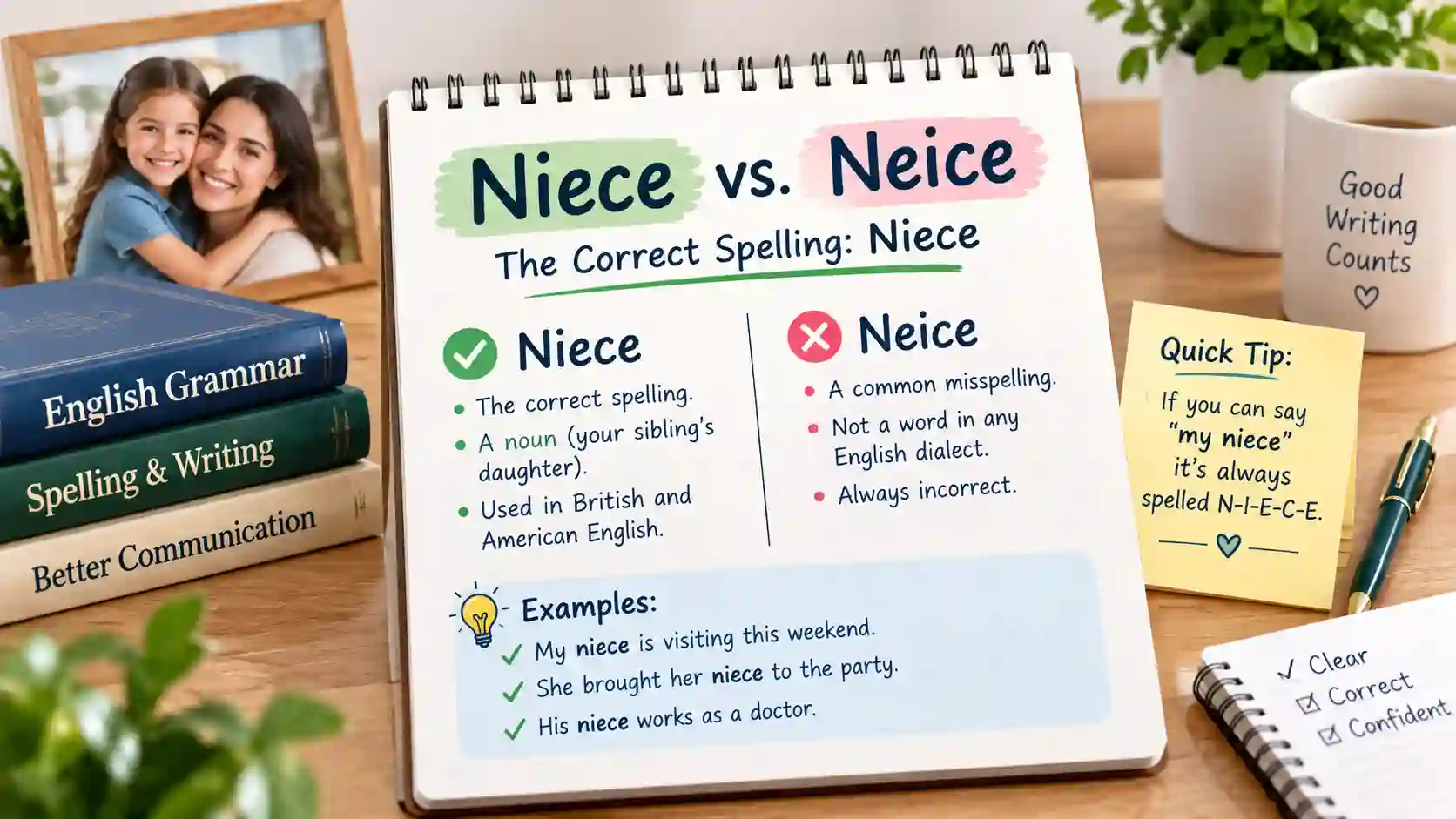
Niece or Neice Quick Answer
“Niece” is the correct spelling. “Neice” is a common misspelling with no accepted use in any English dialect.
A niece is your sibling’s daughter, or your spouse’s sibling’s daughter.
Correct examples:
- My niece turns ten next week.
- She brought her niece to the party.
- His niece works as a doctor.
Incorrect:
- My neice turns ten next week. ❌
There is no British, American, or regional version of English that spells this word “neice.” It’s simply an error.
The Origin of Niece

“Niece” comes from the Old French word nece, which came from the Latin neptis, meaning granddaughter or niece. English borrowed the word during the medieval period, when French heavily influenced English vocabulary after the Norman Conquest.
Over time, French and English spelling settled on “niece,” using the “ie” pattern common in many French loanwords like “piece” and “belief.”
The mix-up with “neice” likely comes from a mental rule: “i before e, except after c.” People apply this rule automatically, without checking if it fits. Since “niece” starts with an “n,” not a “c,” the rule doesn’t apply the way people think it does. Writers sometimes flip the letters anyway, out of habit or memory error.
British English vs American English Spelling
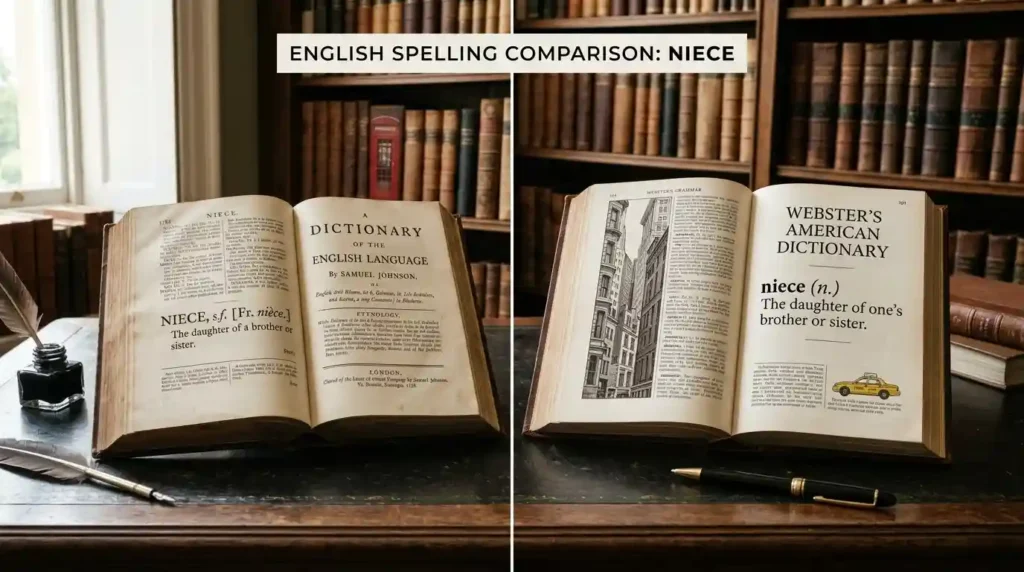
Good news: this is one word where British and American English fully agree. There is no split spelling, like there is with “colour” versus “color” or “realise” versus “realize.”
Both dialects use “niece.” Neither uses “neice.”
| Feature | British English | American English |
| Correct spelling | niece | niece |
| Pronunciation | /niːs/ | /niːs/ |
| Alternate spelling | None | None |
| Common misspelling | neice | neice |
This makes “niece” simpler than many English words. You don’t need to adjust your spelling based on your audience’s country.
Which Spelling Should You Use?
Since “niece” is universal, the advice here is short: always use “niece,” no matter where your reader lives.
For US readers: Use “niece.” No exceptions.
For UK and Commonwealth readers (Canada, Australia, New Zealand, India): Use “niece.” Same word, same spelling.
For global or ESL audiences: Use “niece.” Teach it as a fixed spelling, not a rule-based word. Flashcards and repetition work better here than grammar rules, since the “i before e” rule causes more confusion than it solves.
For formal and professional writing: Always double-check with spell check or a dictionary if you’re unsure. Misspelling family terms in formal documents, like legal papers or obituaries, can look careless.
Common Mistakes with Niece
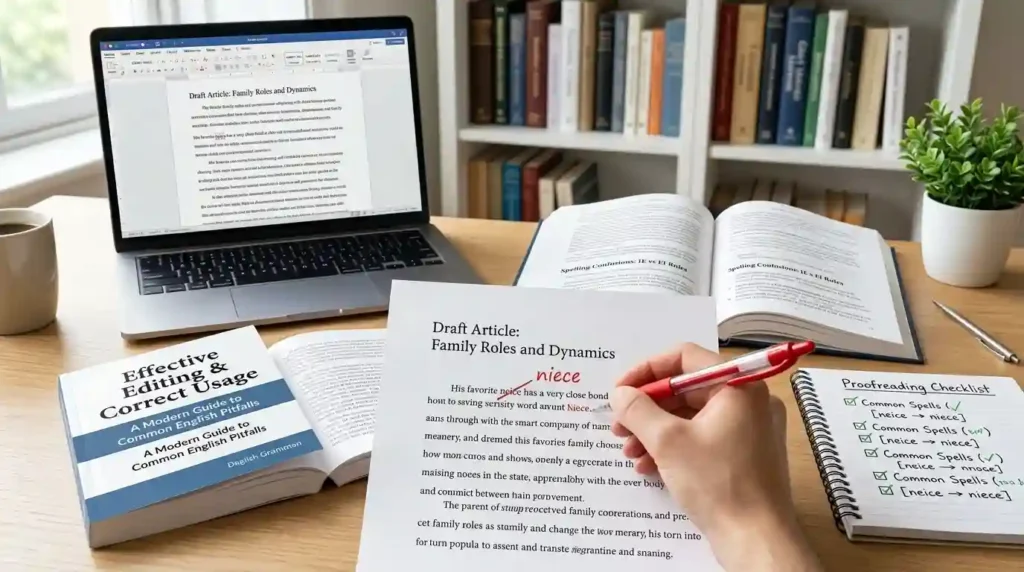
Here are the errors people make most often, and how to fix them.
Mistake 1: Neice
❌ My neice is visiting this weekend.
✅ My niece is visiting this weekend.
Mistake 2: Neice’s (possessive confusion)
❌ That’s my neice’s car.
✅ That’s my niece’s car.
Niece in Everyday Examples
In emails:
“I wanted to let you know that my niece will be joining us for the holidays this year.”
In social media captions:
“Best day ever with my niece at the zoo! 🐘 #FamilyTime”
In formal writing:
“The deceased is survived by his wife, two sons, and a niece, Sarah Thompson.”
In legal or official documents:
“The applicant listed her niece as an emergency contact.”
Across every format, casual or formal, the spelling stays the same: “niece.”
Niece Google Trends & Usage Data
Search data shows “niece” is searched far more often than “neice,” but “neice” still gets meaningful search volume every month. This tells us two things:
- Many people type “neice” by mistake and then search to confirm the correct spelling.
- Search engines and content writers should account for both spellings to reach users at the moment of confusion.
Searches for “niece” tend to spike around holidays, birthdays, and graduation seasons, when people write cards, captions, and speeches involving family members. Interest is fairly steady across the US, UK, Canada, and Australia, with no major regional differences, matching the fact that spelling doesn’t change by country.
Keyword variation comparison:
| Term | Correct? | Search Intent | Usage Recommendation |
| Niece | ✅ Yes | High, steady | Always use |
| Neice | ❌ No | Moderate, mistake-driven | Never use |
| Neice’s | ❌ No | Low | Never use |
| Niece’s | ✅ Yes | Moderate | Use for possessive form |
FAQs
Is “neice” ever correct in any dialect of English?
No. “Neice” is not correct in American, British, Canadian, Australian, or any other standard English dialect. It is always a misspelling.
Why do people spell it “neice” instead of “niece”?
Most people misapply the “i before e, except after c” rule, or simply mistype the letters from memory. The words don’t sound different, so spell-checking by ear doesn’t help.
What is the male version of “niece”?
The male version is “nephew.” A niece is a sibling’s or spouse’s sibling’s daughter; a nephew is the son.
How do you pronounce “niece”?
It’s pronounced “neese,” rhyming with “geese” or “peace.”
What is the plural of “niece”?
The plural is “nieces.” Example: “I have three nieces.”
Is there a difference between “niece” in British and American English?
No. Both dialects use the identical spelling and pronunciation. This is one of the rare words with no regional variation.
Does autocorrect catch “neice” as a mistake?
Not always. Some spell checkers miss it because it resembles a valid letter pattern. Always proofread manually, especially in formal writing.
Conclusion
The answer is simple: “niece” is correct, and “neice” is always wrong. This holds true across American, British, and every other English dialect, making it one of the more straightforward spelling questions in the language.
The confusion usually comes from the “i before e, except after c” rule, which doesn’t apply cleanly here. Rather than relying on that rule, it helps to memorize “niece” as a fixed spelling, the same way you’d memorize a name.
If you’re writing a birthday card, a formal legal document, a news article, or a quick text message, the spelling never changes. There’s no audience-based adjustment needed, unlike many other English words that shift between US and UK usage.
If you take one thing from this article, let it be this: when in doubt, write “niece,” and trust that it’s correct everywhere your writing goes.

“I’m Ibadat Fatima, a professional content writer and author with 3 years of experience in writing, editing, and storytelling. I share my work through visitlivo.com, where I help readers connect with clear, engaging, and well-crafted content.”