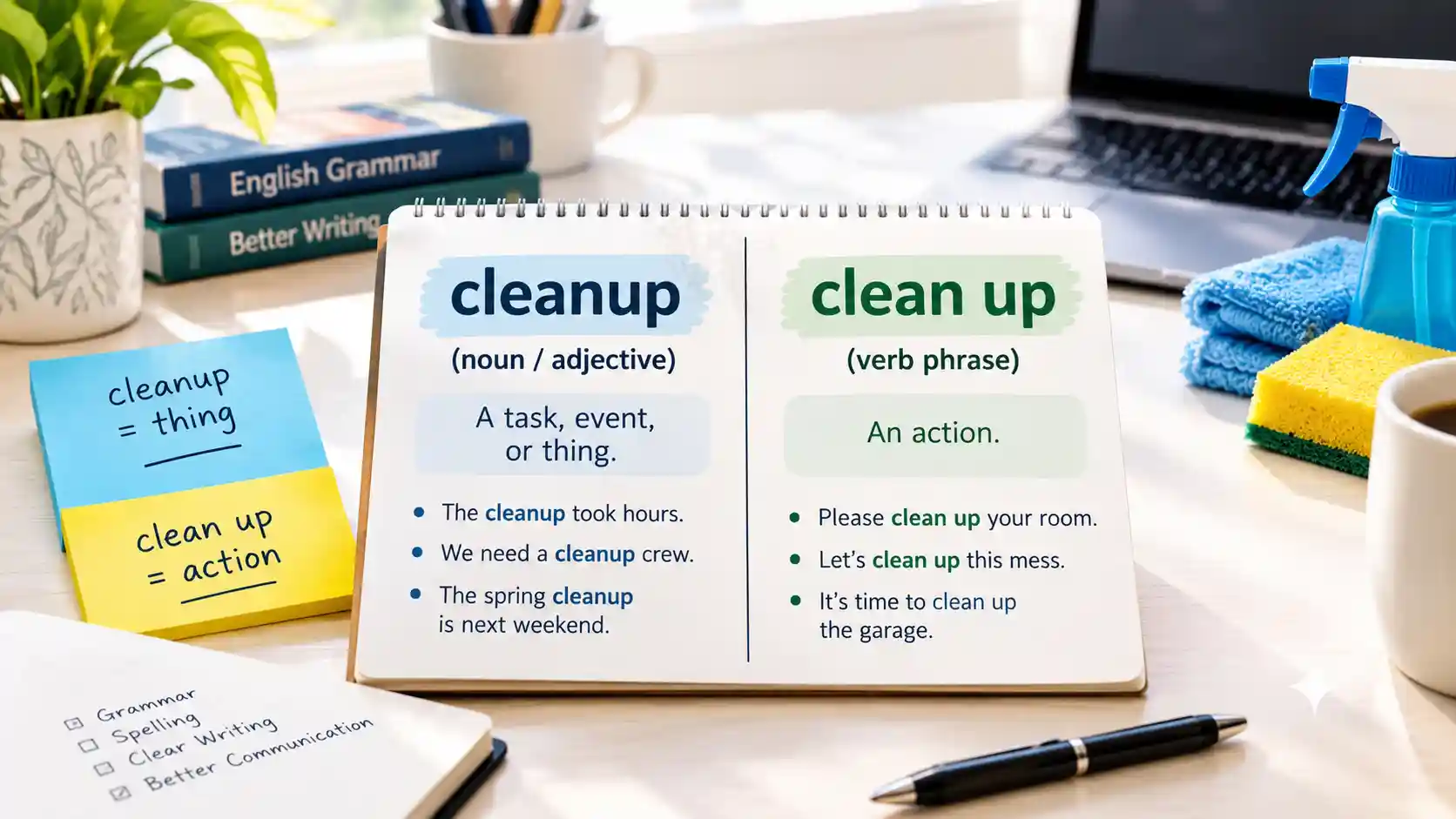
Ever paused mid-sentence, unsure if you should write “cleanup” or “clean up”? You are not alone. This is one of the most common word-mix-ups in English. People search for this because the two forms look almost the same but work in different ways. One is a noun. The other is a verb phrase. Mixing them up can make your writing look careless, especially in emails, resumes, or articles.
This confusion also comes from how English keeps changing. New words often start as two words, then join into one over time. “Clean up” is older. “Cleanup” is newer. Both are correct but only in the right place.
In this guide, you will get a fast answer first. Then we will explain the history, the British vs. American rules, common mistakes, and real examples. By the end, you will never second-guess this word again.
Cleanup or Clean Up Quick Answer
Here is the short version:
- “Clean up” (two words) is a verb phrase. It describes an action.
- Example: “Please clean up your room.”
- “Cleanup” (one word) is a noun or adjective. It names a thing or describes another noun.
- Example: “The cleanup took three hours.”
- Example: “We need a cleanup crew.”
Quick trick: If the word comes right after “to” or acts like an action, use two words. If it names a task, event, or thing, use one word.
The Origin of Cleanup

The phrase “clean up” has been used since the 1700s. It comes from combining “clean” (to make tidy) with the particle “up” (to completion or thoroughness). This pattern is common in English. Think of “wake up,” “fix up,” or “clear up.”
Over time, English speakers began using this phrase as a noun too. Writers merged the two words into one: “cleanup.” This first appeared in American writing in the late 1800s. It became common in business and sports language, like “cleanup hitter” in baseball.
This is why the spelling differs today. The verb form kept its original two-word structure. The noun form evolved into a single, compact word. This pattern happens with many English phrasal verbs:
- Set up → The setup
- Log in → The login
- Break down → The breakdown
“Cleanup” follows this exact rule.
British English vs American English Spelling
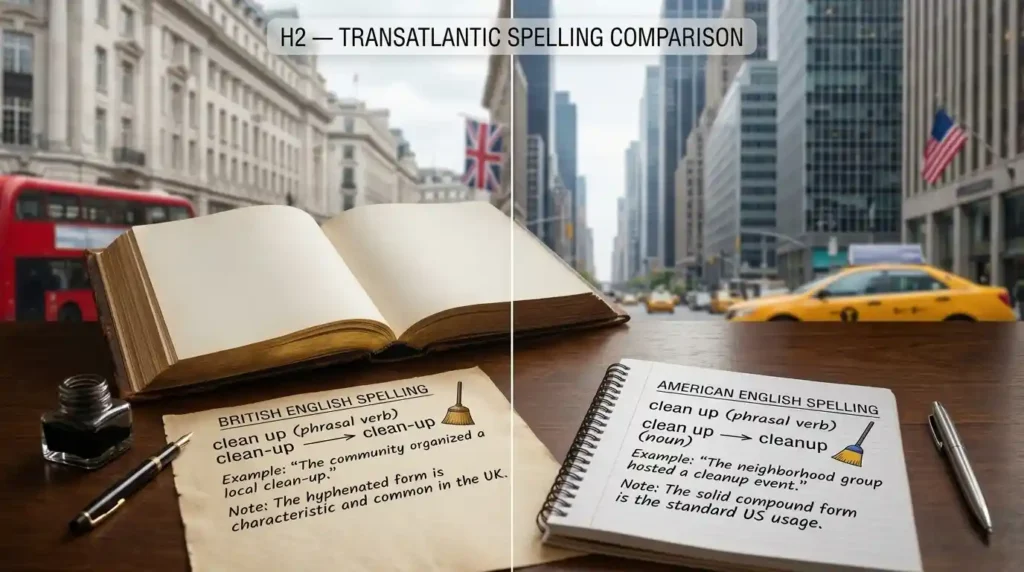
Good news: this rule is the same in both British and American English. The noun/verb split does not change across countries. But usage habits can differ slightly.
American English tends to merge phrasal verbs into single-word nouns faster. British English sometimes keeps a hyphenated form, like “clean-up,” especially in older or more formal writing.
| Form | Word Type | US English | UK English | Example |
| Clean up | Verb | ✅ Standard | ✅ Standard | “Let’s clean up now.” |
| Cleanup | Noun/Adjective | ✅ Standard | ✅ Common | “The cleanup begins today.” |
| Clean-up | Noun/Adjective (hyphenated) | ⚠️ Less common | ✅ Sometimes used | “The clean-up operation was slow.” |
Which Spelling Should You Use?
Your choice depends on grammar first, then audience.
Grammar rule (applies everywhere):
Use “clean up” for actions. Use “cleanup” for things, events, or descriptions.
For US readers:
Stick with “cleanup” as one word for nouns. Avoid the hyphen unless your style guide asks for it.
For UK and Commonwealth readers:
“Cleanup” and “clean-up” are both accepted. Check your company or publication’s style guide. News outlets like the BBC sometimes use the hyphen.
For global or mixed audiences:
Use “cleanup” (one word, no hyphen). It is the most widely recognized and understood form across English-speaking countries.
Common Mistakes with Cleanup
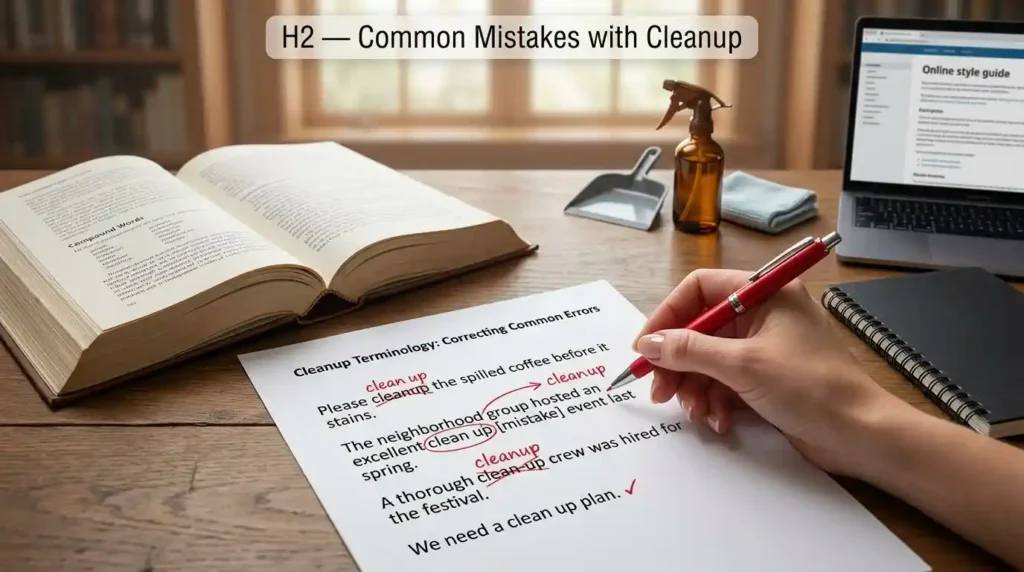
Here are frequent errors people make:
- Wrong: “I need to cleanup my desk.”
Right: “I need to clean up my desk.” (It’s an action.) - Wrong: “The clean up is scheduled for Monday.”
Right: “The cleanup is scheduled for Monday.” (It’s a noun, so no space.) - Wrong: “We hired a clean up team.”
Right: “We hired a cleanup team.” (Used as an adjective before “team.”) - Wrong: “Let’s cleanup this mess together.”
Right: “Let’s clean up this mess together.”
A simple test: try replacing the word with “tidy.” If it fits as an action (“tidy up”), use two words. If it fits as a label (“the tidying”), use one word.
Cleanup in Everyday Examples
In emails:
“Please clean up the shared folder by Friday. The cleanup will help everyone find files faster.”
In social media posts:
“Weekend project: time to clean up my closet 🧹 #cleanup #organized”
In formal writing:
“The environmental cleanup project required coordination between three agencies. Workers were instructed to clean up hazardous materials within 48 hours.”
In sports:
“He batted cleanup for the third game in a row.”
Cleanup Google Trends & Usage Data
Search interest in terms like “cleanup” and “clean up” stays steady year-round, with spikes during spring cleaning season, after natural disasters, and around New Year resolutions.
In the United States, “cleanup” (one word) is the more common search and usage form, especially in business, tech, and environmental contexts. In the UK, Australia, and Canada, both “cleanup” and “clean-up” appear in search results and news writing, though “cleanup” is gaining ground due to American media influence online.
Globally, “cleanup” is the dominant spelling in digital content, marketing, and SEO writing. This makes it the safer default choice for websites and apps targeting international audiences.
| Variation | Common Region | Typical Use |
| Cleanup | US, Global | Noun, adjective |
| Clean up | US, UK, Global | Verb phrase |
| Clean-up | UK, Australia | Noun (formal/older style) |
Frequently Asked Questions
Is “cleanup” one word or two?
It depends on use. As a noun (“the cleanup”), it’s one word. As a verb (“clean up the room”), it’s two words.
Is “clean-up” with a hyphen correct?
Yes, especially in British English or formal writing. It is less common in American English.
What is the verb form of “cleanup”?
The verb form is “clean up” (two words), as in “Please clean up your desk.”
Can “cleanup” be used as an adjective?
Yes. Example: “cleanup crew,” “cleanup operation,” “cleanup effort.”
Which spelling does Google prefer for SEO?
“Cleanup” (one word) typically has higher search volume in the US and works well for global content.
Is “cleanup” American or British English?
It is used in both, but American English favors the one-word form more consistently.
How do I remember the difference?
If you can say “clean it up,” it’s two words. If it names a task or event, it’s one word.
Conclusion
“Cleanup” and “clean up” are not interchangeable, but the rule is simple once you know it. Use “clean up” (two words) when describing an action, like cleaning a room or fixing a mess. Use “cleanup” (one word) when naming a thing, task, or event, like a cleanup crew or a spring cleanup.
This distinction applies across American, British, and global English. The only regional difference is that British English sometimes uses a hyphenated “clean-up” for the noun form, while American English almost always drops the hyphen.
When in doubt, try the simple test: does the word describe doing something, or naming something? Actions get two words. Names get one.
Getting this right makes your writing look polished, if you’re sending a work email, writing a blog post, or creating content for a global audience. Now you have the quick answer, the reasoning behind it, and real examples to use with confidence.

I’m Raheela Rani, a professional content writer and author with 3 years of experience in writing, editing, and storytelling. Through VisitLivo.com, I create clear, engaging, and well-crafted content that helps readers learn, connect, and communicate with confidence.