
You are filling out a job form. Or writing your résumé. You reach the education line and stop. Is it “bachelor degree” or “bachelor’s degree”? Does it need an apostrophe? Should it have a capital letter?
You are not alone. Many people search this question every year. The words look almost the same, but one small mark changes the meaning. Students, job seekers, writers, and teachers all get stuck on it.
This guide clears up the confusion. You will get the quick answer first. Then you will learn where the word came from, how US and UK writers use it, and which mistakes to avoid. You will also see real examples, comparison tables, and answers to common questions.
By the end, you will know which form to write. You will also know why it is correct, so you never have to look it up again.
Bachelor or Bachelor’s Degree Quick Answer
“Bachelor’s degree” is the correct form. It has an apostrophe and an “s.”
The apostrophe shows ownership. It is the degree of a bachelor, a person who has reached the first level of university study.
Here are the correct forms:
- She has a bachelor’s degree in biology.
- He earned a Bachelor of Arts from the university.
- They each hold a bachelor’s in business.
- Many jobs ask for a bachelor’s degree.
Here are the wrong forms:
- ❌ She has a bachelor degree.
- ❌ She has a bachelors degree.
“Bachelor” on its own is a different word. It usually means an unmarried man. When you talk about a degree, add the apostrophe and “s.”
The Origin of Bachelor’s Degree

The word “bachelor” is very old. It comes from Old French bacheler, which meant a young knight in training. That word likely came from Medieval Latin baccalarius, a word for a young farm worker or servant.
Over time, the meaning grew. By the Middle Ages, universities used the word for a student who had finished the first stage of study. He was not yet a master, but he was more than a beginner.
Some people link the word to the Latin baccalaureus, which sounds like “laurel berry.” Laurel wreaths were a sign of honor. This link is a popular story, but scholars believe the two words were mixed up over time. That is why the degree is still called a baccalaureate in some places.
So why the apostrophe? English often uses “‘s” to show that something belongs to someone. A “bachelor’s degree” is a degree that belongs to a bachelor. Some people drop the “‘s” because it is easy to forget. Writers who do this are writing a shortcut, not the standard form.
British English vs American English Spelling
Here is a surprise. British and American English both use “bachelor’s degree.” The apostrophe rule is the same in both. The real differences are in nearby words and habits.
| Feature | American English | British English |
| Common form | bachelor’s degree | bachelor’s degree |
| Formal title | Bachelor of Arts (BA) | Bachelor of Arts (BA) |
| Science abbreviation | BS or BSc | BSc |
| Everyday word for it | “a bachelor’s” | “a first degree” or “an undergraduate degree” |
| Honors | Cum laude, magna cum laude | First-class honours, 2:1, 2:2 |
| Spelling of “honors” | honors | honours |
| Lowercase in general use? | Yes | Yes |
Notice the spelling “honors” vs “honours.” That is a real US–UK spelling difference. The word “bachelor’s” itself does not change.
The key point: the “bachelor or bachelor’s” question is not about British or American spelling. It is about grammar. The apostrophe is correct in both.
Which Spelling Should You Use?
Use “bachelor’s degree” in every case. Here is how to think about each audience.
If you write for a US audience: Use “bachelor’s degree.” Style guides such as AP and Chicago both use it. Write “bachelor’s” without “degree” if the meaning is clear.
If you write for a UK or Commonwealth audience: Use “bachelor’s degree” too. You may also see “undergraduate degree” or “first degree.” These are fine and are common in the UK, India, Pakistan, Australia, and Nigeria.
If you write for a global audience: Use “bachelor’s degree.” It is the most widely understood form. It works on résumés, websites, and official forms.
If you write the full degree name: Use capital letters and drop the apostrophe. Write “Bachelor of Science in Nursing.” Here “Bachelor” starts the official title, so it is not possessive.
A simple rule: general talk gets “bachelor’s degree” in lowercase. A full title gets capital letters and no apostrophe.
Common Mistakes with Bachelor’s Degree
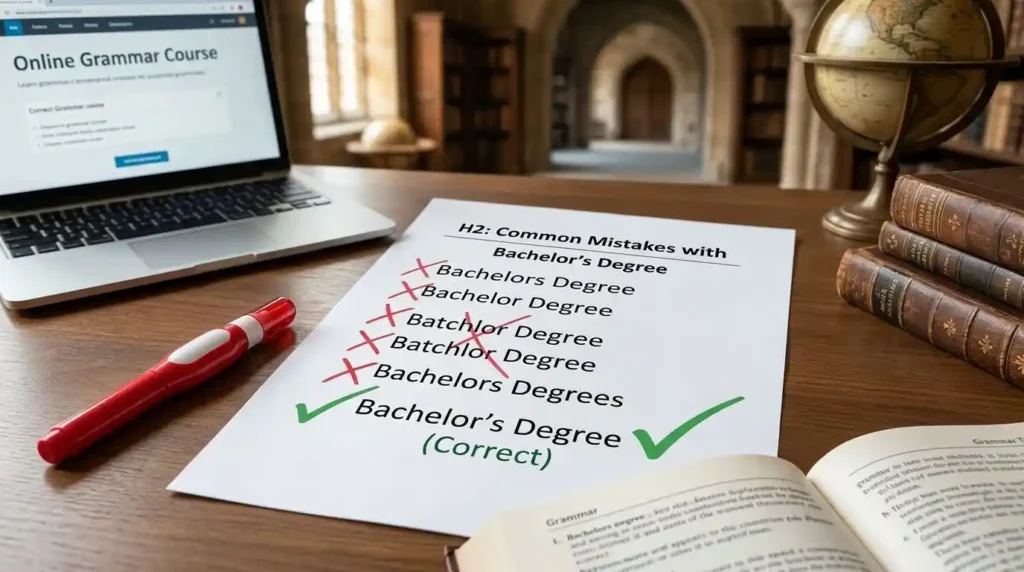
Here are the errors people make most often.
1. Leaving out the apostrophe
❌ She holds a bachelors degree.
✅ She holds a bachelor’s degree.
2. Leaving out the “s”
❌ He has a bachelor degree.
✅ He has a bachelor’s degree.
3. Putting the apostrophe in the wrong place
❌ She has a bachelors’ degree.
✅ She has a bachelor’s degree.
There is one degree and one bachelor, so the apostrophe goes before the “s.”
4. Using capital letters when you should not
❌ He has a Bachelor’s Degree.
✅ He has a bachelor’s degree.
Only capitalize it in a full title, like “Bachelor of Arts.”
5. Adding an apostrophe to the full title
❌ Bachelor’s of Science
✅ Bachelor of Science
6. Writing the plural the wrong way
❌ Two bachelor degrees
✅ Two bachelor’s degrees
Bachelor’s Degree in Everyday Examples
In an email:
Dear Ms. Khan, I have a bachelor’s degree in computer science and three years of experience. Please find my résumé attached.
In a news story:
The report found that workers with a bachelor’s degree earn more, on average, than workers without one.
On social media:
Finally done! Four years, one bachelor’s degree. Thank you all for the support. 🎓
In formal writing (a résumé or CV):
Bachelor of Science in Accounting, State University, 2024
In a job ad:
Requirements: bachelor’s degree in marketing or a related field.
In a school website:
Our Bachelor of Arts in English takes four years to complete.
Notice the pattern. Casual and news writing use the lowercase “bachelor’s degree.” Titles use capitals and no apostrophe.
Bachelor’s Degree Google Trends & Usage Data

Exact numbers change every week, so check Google Trends for the latest figures. Here is what usually shows up.
Where people search: Interest tends to be strong in countries where English is used for study and work. These include the United States, India, Pakistan, the Philippines, Nigeria, and the United Kingdom.
When people search: Searches often rise around university application season, graduation time, and job-hunting periods.
Which form is more common: “Bachelor’s degree” is far more common in books, news, and official documents than “bachelor degree.” Still, “bachelor degree” appears often in search boxes. That is because many people are unsure and type both.
Why the mistake is common: In some languages, nouns can be used as adjectives with no change. Writers from those languages may naturally write “bachelor degree.” It is an easy habit to pick up.
Keyword Variations Side by Side
| Variation | Correct? | Notes |
| bachelor’s degree | ✅ Yes | Standard form in US, UK, and worldwide |
| bachelor degree | ❌ No | Common error; missing “‘s” |
| bachelors degree | ❌ No | Missing apostrophe |
| bachelors’ degree | ❌ No | Apostrophe in wrong place |
| Bachelor’s Degree | ⚠️ Only in titles or headings | Do not capitalize in normal sentences |
| Bachelor of Arts / Science | ✅ Yes | Full title; no apostrophe |
| a bachelor’s | ✅ Yes | Short form, when the meaning is clear |
| baccalaureate | ✅ Yes | Formal or older word for the same degree |
Frequently Asked Questions
Is it “bachelor degree” or “bachelor’s degree”?
It is “bachelor’s degree.” The apostrophe and “s” show that the degree belongs to a bachelor.
Is “bachelors degree” ever correct?
No. It is missing the apostrophe. Always write “bachelor’s.”
Should I capitalize “bachelor’s degree”?
Not in normal sentences. Only capitalize the full title, such as “Bachelor of Arts.”
Is there a difference between British and American spelling here?
No. Both use “bachelor’s degree.” The UK also says “undergraduate degree” or “first degree,” but the spelling stays the same.
What is the plural of “bachelor’s degree”?
It is “bachelor’s degrees.” Only “degree” changes. For example: “She has two bachelor’s degrees.”
Do I need an apostrophe in “Bachelor of Science”?
No. In the full title, “Bachelor” is not possessive. Write “Bachelor of Science.”
Can I write just “a bachelor’s”?
Yes. In casual writing, “She earned a bachelor’s in history” is fine.
How do I write it on my résumé?
Use the full title: “Bachelor of Science in Biology.” You may also write “B.S. in Biology” or “BSc in Biology.”
Conclusion
The answer is simple. Write “bachelor’s degree.” It has an apostrophe and an “s,” and it is correct in American English, British English, and global English.
Here are the key points to remember:
- “Bachelor’s degree” means a degree of a bachelor. The apostrophe shows that.
- “Bachelor degree” and “bachelors degree” are common errors.
- Do not capitalize it in normal sentences.
- Do capitalize the full title, such as “Bachelor of Arts,” and skip the apostrophe there.
- The plural is “bachelor’s degrees.”
- British and American writers agree on this one. The differences lie in nearby words, like “honors” and “honours.”
The word itself has a long story. It began as a word for a young knight and grew into the name for a first university degree. The small apostrophe is a tiny piece of that history.
Next time you write your résumé, email, or essay, you will know what to type. Use “bachelor’s degree” with confidence, and check your capital letters. That is all it takes to get it right.
I’m Raheela Rani, a professional content writer and author with 3 years of experience in writing, editing, and storytelling. Through VisitLivo.com, I create clear, engaging, and well-crafted content that helps readers learn, connect, and communicate with confidence.