
You type the word. It looks wrong. You add a second T. It still looks wrong.
That’s the trap “targeted” sets for millions of writers every year. English has a habit of doubling letters before “-ed” “stopped,” “planned,” “regretted” so your brain reaches for a double T here too. It’s a reasonable guess. It’s also incorrect.
This word causes real confusion for three reasons. First, spell-checkers don’t always flag the mistake. Second, British English is famous for doubling consonants that American English doesn’t (think “travelled” vs. “traveled”), so many writers assume this word splits along the same lines. Third, the actual grammar rule behind it which involves syllable stress almost never gets explained in plain terms.
This guide fixes all three problems. You’ll get the correct spelling in one sentence, then the full reasoning, a side-by-side British vs. American breakdown, the mistakes people make most often, and answers to the questions writers ask most. Read it once and this word stops being a guessing game.
Targeted or Targetted Quick Answer
Targeted is correct. One T. Every time.
“Targetted” is a misspelling. No major dictionary American, British, or otherwise lists it as an accepted variant.
Correct:
- The campaign targeted first-time buyers.
- Schools now offer targeted support for struggling readers.
- The strike targeted a supply depot.
Incorrect:
- ❌ The campaign targetted first-time buyers.
- ❌ The ad was targetted at teenagers.
The present participle follows the same rule: targeting, not “targetting.”
The Origin of Targeted

“Target” traces back to the Old French word targe, meaning a small round shield. By the 1300s, English had borrowed it as “target” to describe that same shield. Over the following centuries, the meaning shifted first to an object you shoot at, then to any goal or objective you’re aiming for. By the 20th century, “target” had fully entered business and military language as a verb: to target a market, an audience, a location.
The spelling confusion traces back to a different, older rule one about consonant doubling. In English, a short verb ending in a single consonant after a single vowel usually doubles that consonant before “-ed” or “-ing,” but only when the stress falls on the final syllable. That’s why “stop” becomes “stopped” and “prefer” becomes “preferred.”
Say “target” out loud. The stress lands on the first syllable TAR-get not the second. Because the stress falls in the wrong place for the rule to apply, the T never doubles. “Targeted” is simply “target” plus “-ed,” nothing more.
British English vs American English Spelling
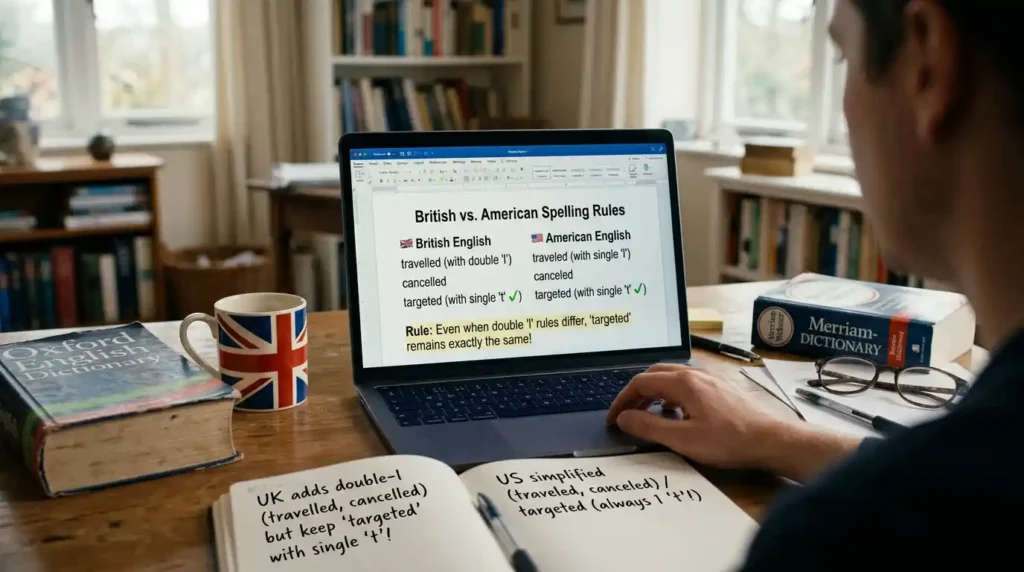
Most of the famous British-vs-American spelling gaps come from consonant doubling, especially with the letter L. British English doubles a final L almost regardless of stress “travelled,” “cancelled,” “modelled” while American English typically leaves it single: “traveled,” “canceled,” “modeled.”
“Targeted” doesn’t fall into that gap. The stress-based doubling rule that governs most other consonants still applies on both sides of the Atlantic, and “target” fails that test in both dialects equally. So instead of a US/UK split, you get full agreement: one T, everywhere.
| Word | American English | British English | Why |
| Target → Targeted | targeted | targeted | Stress on 1st syllable no doubling, either dialect |
| Travel → Travelled/Traveled | traveled | travelled | British doubles final “L” regardless of stress |
| Cancel → Cancelled/Canceled | canceled | cancelled | British doubles final “L” regardless of stress |
| Prefer → Preferred | preferred | preferred | Stress on final syllable doubles in both |
| Format → Formatted | formatted | formatted | Stress on final syllable doubles in both |
| Visit → Visited | visited | visited | Stress on 1st syllable no doubling, either dialect |
Bottom line: “targeted” is one of the rare words where American and British spelling never disagree.
Which Spelling Should You Use?
- Writing for a US audience: Use “targeted.” No regional exception exists.
- Writing for a UK or Commonwealth audience (Canada, Australia, New Zealand, South Africa): Use “targeted.” Despite the general British tendency to double consonants, this word doesn’t follow that pattern.
- Writing for a global or mixed audience: Use “targeted.” It’s the only spelling recognized as correct worldwide, so it carries zero risk of confusing any reader.
For marketing copy, journalism, academic writing, or business communication, “targeted” is the only defensible choice.
Common Mistakes with Targeted

- Doubling the T by habit writing “targetted” because it resembles “committed” or “regretted.”
- Doubling the T in the -ing form “targetting” instead of “targeting.”
- Assuming British English doubles it it doesn’t; the stress rule overrides the regional habit here.
- Trusting autocorrect without a second look some spell-checkers miss “targetted” entirely.
- Switching spellings mid-document using “targeted” in one paragraph and “targetted” in another undermines the whole piece.
Quick fix:
- ❌ “The email was targetted at new subscribers.”
- ✅ “The email was targeted at new subscribers.”
Targeted in Everyday Examples
Email: “This offer is targeted at customers who joined before June.”
News headline: “New policy offers targeted relief for small businesses.”
Social media ad: “Reach a highly targeted audience with our new ad tools.”
Formal writing: “The study used a targeted sampling method to reduce bias.”
Healthcare: “Doctors recommended a targeted treatment plan based on the diagnosis.”
The spelling never shifts, no matter how casual or formal the setting.
Targeted Google Trends & Usage Data

Search interest in this spelling question tends to cluster in countries with large numbers of content marketers and English learners the US, UK, India, Canada, and the Philippines rank consistently high. That tracks with how often the word shows up in advertising and marketing language: “targeted ads,” “targeted audience,” and “targeted campaign” are everyday phrases in that industry.
“Targetted” still pulls meaningful search volume, mostly from writers double-checking a word that looks plausible next to “committed” or “regretted.” But in edited, professional content newspapers, journals, major brand copy “targeted” wins by a wide margin. The double-T version rarely survives an editor’s pass.
Comparison Table: Targeted vs Targetted vs Targeting
| Form | Spelling | Status | Example |
| Targeted | 1 T | ✅ Correct (US & UK) | “The ad was targeted at parents.” |
| Targetted | 2 T’s | ❌ Incorrect | “The ad was targetted at parents.” |
| Targeting | 1 T | ✅ Correct | “We are targeting new markets.” |
| Targetting | 2 T’s | ❌ Incorrect | “We are targetting new markets.” |
FAQs
Is “targetted” ever correct?
No, not in any context, region, or style guide. It’s a misspelling.
Why doesn’t “target” double its final consonant like “stop” does?
Because the doubling rule only kicks in when stress falls on the last syllable. “Target” is stressed on the first syllable, so the T stays single.
Do British and American English spell this word differently?
No. Unlike “colour/color” or “travelled/traveled,” this word is identical in both dialects: targeted.
Is it “targeting” or “targetting”?
Targeting, with one T. Same stress rule applies.
Why do people keep making this mistake?
“Targetted” resembles words like “committed” and “regretted,” which genuinely do double their final consonant. The brain overgeneralizes the pattern.
Can I rely on spell-check to catch this?
Not always some tools miss it. A manual check is worth the ten seconds.
Is “targeted” a verb, an adjective, or both?
Both. As a verb: “She targeted the root cause.” As an adjective: “a targeted marketing strategy.”
Conclusion
There’s one rule to remember here, and it never bends: write targeted, never “targetted.” That’s true if your reader is in New York, London, Sydney, or Mumbai, and true if you’re writing a tweet or a thesis.
The confusion makes sense English really does double consonants in look-alike words like “committed” and “regretted.” But “target” carries its stress on the first syllable, not the last, and that single fact is why the doubling rule skips right past it. The same logic keeps “targeting” at one T as well.
Get this word right and it becomes invisible which is exactly what good spelling should be. Get it wrong, and it’s the kind of small slip that makes careful readers pause. One T, every time, everywhere.

I’m Raheela Rani, a professional content writer and author with 3 years of experience in writing, editing, and storytelling. Through VisitLivo.com, I create clear, engaging, and well-crafted content that helps readers learn, connect, and communicate with confidence.