You are staring at a chemistry question. It asks about water. Is H2O ionic or covalent? You know water is the most famous molecule on Earth. Still, the answer feels tricky. Water can dissolve salt. Salty water can carry an electric current. A tiny bit of water even splits into ions. So it must be ionic, right? Not so fast.
People search “h2o ionic or covalent” for one big reason. The two ideas sound alike, and tests love to mix them up. Students want a fast answer for homework. Teachers want a clear way to explain it. Curious readers just want the truth.
This guide clears up the confusion. You get the short answer first. Then you learn why water is covalent, where the words came from, and how to tell the two bond types apart. You will also see common mistakes, real examples, comparison tables, and an FAQ. By the end, you will not mix them up again.
H2O Ionic or Covalent Quick Answer
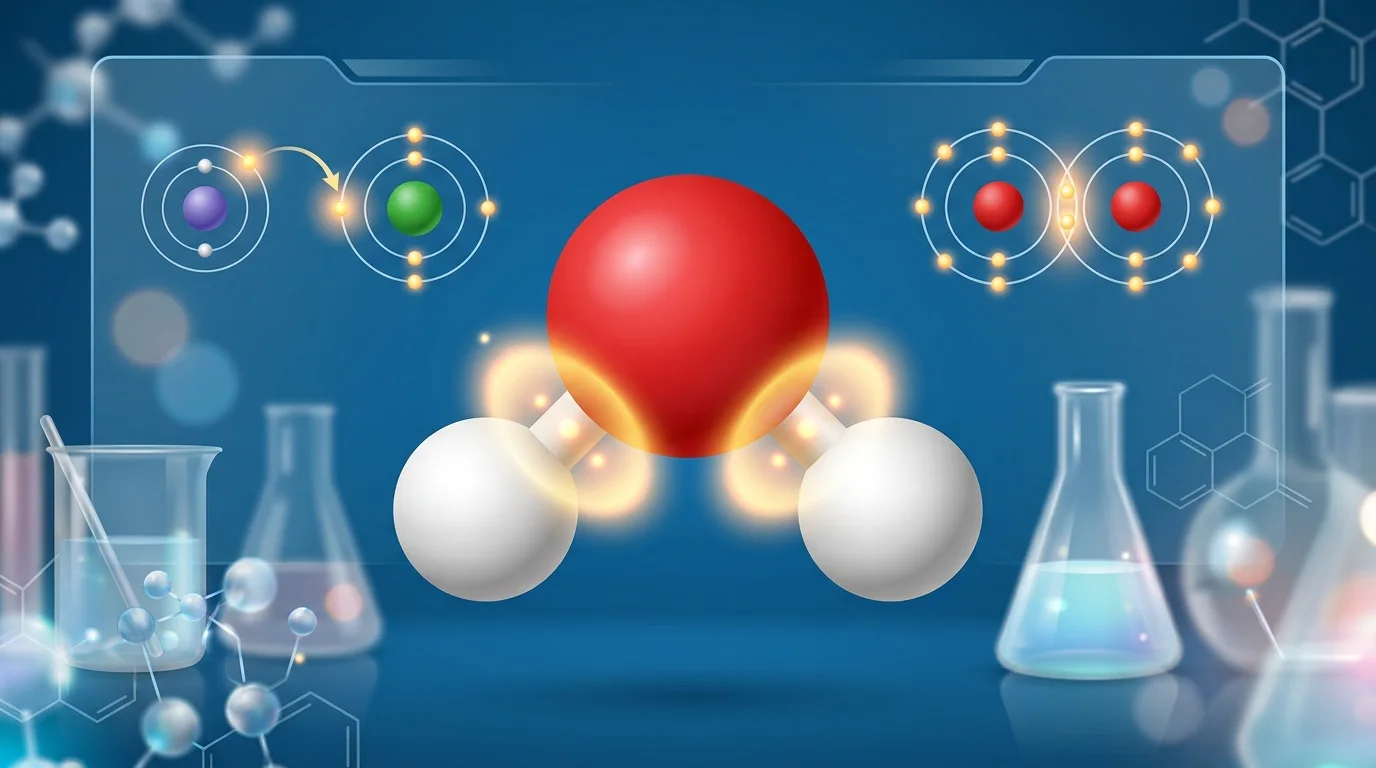
H2O is covalent. More exactly, it is polar covalent.
Here is why:
- Oxygen and hydrogen are both nonmetals.
- They share electrons. They do not hand them over.
- Oxygen pulls the shared electrons a bit harder. That makes water “polar.”
Quick examples:
- H2O (water): covalent
- CO2 (carbon dioxide): covalent
- NaCl (table salt): ionic
- CH4 (methane): covalent
Rule of thumb: metal plus nonmetal is usually ionic. Nonmetal plus nonmetal is usually covalent. Water is nonmetal plus nonmetal. So it is covalent.
The Origin of H2O Ionic or Covalent
The question exists because of two old ideas in chemistry.
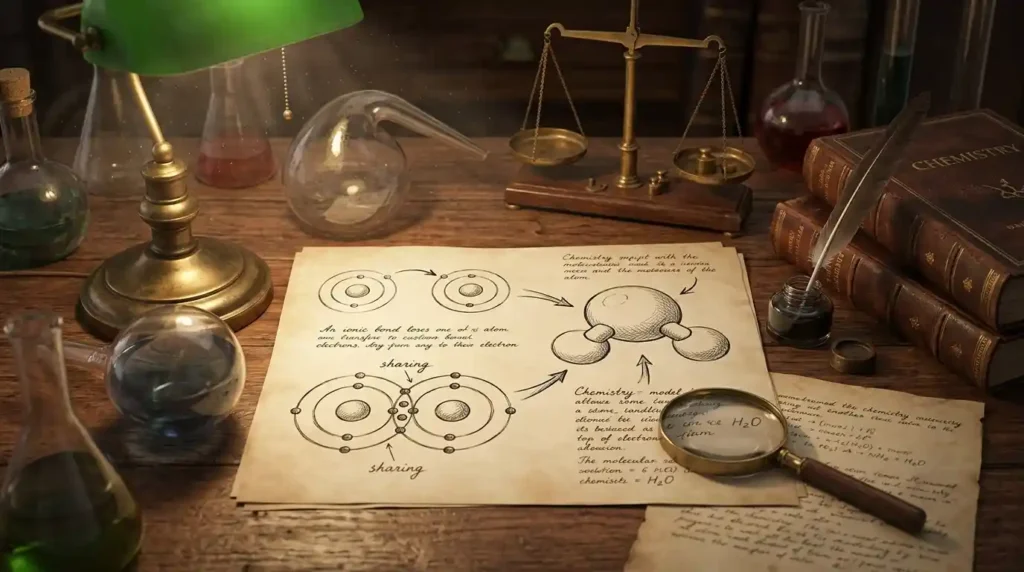
Ionic. The word “ion” comes from a Greek word meaning “going.” In the 1830s, Michael Faraday used it for charged particles that seem to travel through liquids. An ionic bond forms when one atom gives electrons to another. The atoms become charged and stick together like magnets.
Covalent. In 1916, Gilbert N. Lewis described bonds as shared pairs of electrons. In 1919, Irving Langmuir gave this kind of bond the name “covalent.”
Why water causes confusion. Water acts a bit like an ionic thing:
- It dissolves many salts.
- It can conduct electricity when salt is in it.
- A very tiny share of water molecules split into H₃O⁺ and OH⁻ ions.
Those facts are real. But the water molecule itself is held together by shared electrons. That is a covalent bond.
Ionic vs Covalent Side-by-Side Comparison
The confusion here is not spelling. It is the two bond types. Here is how they differ.
| Feature | Ionic Bond | Covalent Bond |
| What happens to electrons | Transferred | Shared |
| Typical atoms | Metal + nonmetal | Nonmetal + nonmetal |
| Example | NaCl, MgO | H2O, CO2, CH4 |
| Melting point | Usually high | Usually lower |
| Conducts electricity as a solid | No | No |
| Conducts when dissolved | Yes | Usually no |
| Structure | Crystal lattice | Separate molecules |
A note on “polar.” Covalent bonds come in two types:
- Nonpolar: electrons are shared equally (like O₂).
- Polar: electrons are shared unequally (like H2O).
In water, oxygen is more electronegative than hydrogen. The electrons sit closer to oxygen. Oxygen gets a slight negative charge. Hydrogen gets a slight positive charge. The molecule is also bent, at about 104.5 degrees, so the charges do not cancel out.
Which Answer Should You Use?
The answer is always “covalent.” But how you say it depends on who is asking.
For school homework and quizzes: Write “covalent.” If space allows, add “polar covalent.”
For exams (high school or college): Write “polar covalent.” Add one reason: “Oxygen and hydrogen share electrons unequally.”
For a general audience or a blog: Say “Water is covalent. It only acts a bit like an ionic compound because it dissolves salts.”
For formal or lab writing: Use full terms. Write “polar covalent bonds between hydrogen and oxygen atoms.” Mention hydrogen bonding if you discuss how molecules interact.
For global readers: Use the formula “H2O” (or H₂O) and the word “covalent.” Both are the same in the US, UK, and around the world.
Common Mistakes with H2O Ionic or Covalent
Mistake 1: “Water dissolves salt, so it is ionic.”
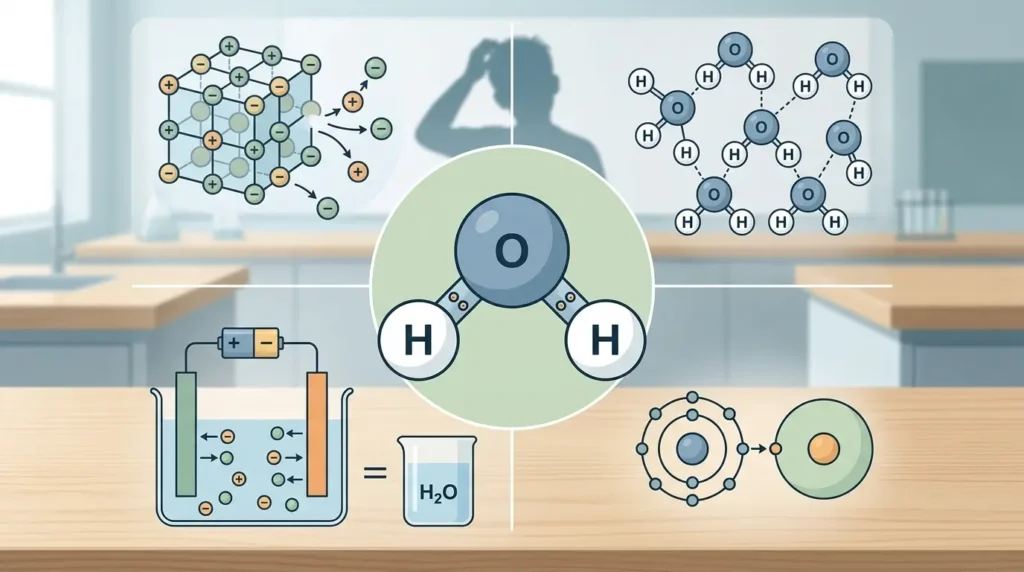
Fix: Water dissolves salt because it is polar. The polarity is what makes it a good solvent. The bond inside water is still covalent.
Mistake 2: “Water conducts electricity, so it is ionic.”
Fix: Pure water is a very poor conductor. Tap water conducts because of dissolved salts and minerals.
Mistake 3: “Polar means ionic.”
Fix: Polar covalent is still covalent. Electrons are shared, just not evenly.
Mistake 4: “Covalent means nonpolar.”
Fix: Covalent bonds can be polar or nonpolar. Water is polar.
Mistake 5: Mixing up bonds and forces.
Fix: The hydrogen bond between water molecules is a weak attraction. It is not the same as the covalent bond inside each molecule.
Mistake 6: Writing “H20” with a zero.
Fix: The correct formula is H2O, with the letter O.
H2O Ionic or Covalent in Everyday Examples
In a school email:
“Hi Ms. Khan, is H2O ionic or covalent? I think it is covalent because both atoms are nonmetals. Can you confirm?”
In news or science writing:
“Scientists explained that water is a polar covalent molecule. That is why it can dissolve so many substances.”
On social media:
“Reminder for chem students: water is covalent, not ionic. It dissolves salt because it is polar. 💧”
In formal writing (lab report):
“The O–H bonds in water are polar covalent. The unequal sharing of electrons gives the molecule a partial charge on each end.”
In a study note:
“H2O = polar covalent. NaCl = ionic. CO2 = covalent. Metal + nonmetal = ionic.”
H2O Ionic or Covalent Google Trends & Usage Data

I cannot give you exact live numbers here, and I do not want to make any up. You can check the real data yourself in Google Trends. Search for the keyword and compare regions and dates.
What to expect from a question like this:
- Seasonal peaks. Interest usually rises during school terms and exam season. It usually dips during long school holidays.
- Student-heavy countries. Countries with many English-speaking chemistry students tend to search more. Examples include the US, India, the UK, Pakistan, the Philippines, Canada, and Australia.
- Search context. Most people want a quick answer for homework or a test. Many also search related questions, such as if water is polar.
Tips for using Trends:
- Compare “is water ionic or covalent” with “h2o ionic or covalent.”
- Set the date range to 5 years to see the yearly cycle.
- Check “Related queries” for new ideas to cover.
Keyword Variations Side by Side
| Search Phrase | What the Person Wants | Short Answer |
| h2o ionic or covalent | Bond type of water | Covalent |
| is water ionic or covalent | Same question, plain words | Covalent |
| is h2o polar or nonpolar | Shape and charge | Polar |
| is h2o a molecular compound | Compound type | Yes |
| does water have ionic bonds | Bond check | No |
| is h2o an ionic compound | Compound type | No |
| why is water polar covalent | The reason | Unequal sharing of electrons |
FAQs
Is H2O ionic or covalent?
It is covalent. Hydrogen and oxygen share electrons.
Is H2O polar or nonpolar?
It is polar. Oxygen pulls electrons harder, and the molecule is bent.
Why does water dissolve salt if it is not ionic?
Water’s slight charges pull on the ions in salt. The negative end of water grabs positive ions. The positive end grabs negative ions. So salt breaks apart.
Does water conduct electricity?
Pure water barely does. Water with dissolved salts conducts well.
Does water have any ions in it?
Yes, a tiny amount. A very small share of water molecules split into H₃O⁺ and OH⁻. This does not make the water molecule ionic.
What is the difference between a polar covalent bond and an ionic bond?
In a polar covalent bond, electrons are shared unevenly. In an ionic bond, electrons are fully transferred.
How can I tell quickly if a compound is ionic or covalent?
Look at the elements. Metal plus nonmetal is usually ionic. Nonmetal plus nonmetal is usually covalent.
Is the hydrogen bond in water ionic?
No. A hydrogen bond is a weak attraction between molecules. It is not an ionic bond.
Conclusion
So, is H2O ionic or covalent? The answer is covalent. Water is a polar covalent molecule. Hydrogen and oxygen are both nonmetals, and they share electrons. Oxygen pulls the electrons a little closer, which gives water its slight charges and its bent shape.
Water can look ionic because it dissolves salt, carries current when salty, and makes a few ions. But those facts describe how water behaves, not how its atoms are bonded. Do not mix up the two.
Here are the key takeaways:
- H2O is covalent, and more precisely, polar covalent.
- Metal plus nonmetal is usually ionic. Nonmetal plus nonmetal is usually covalent.
- Polar does not mean ionic.
- Water dissolves salt because it is polar.
- On a test, write “polar covalent” and give one short reason.
Use the simple rule and the comparison tables above whenever you are unsure. With a little practice, questions like this become easy points on any chemistry test.
.

“I’m Ibadat Fatima, a professional content writer and author with 3 years of experience in writing, editing, and storytelling. I share my work through visitlivo.com, where I help readers connect with clear, engaging, and well-crafted content.”