You are typing a text. You pause. Is it “anyway” or “any way”? You are not alone. This is one of the most searched grammar questions in English. Millions of people stop mid-sentence over this exact word.
Why does this happen? Because the two forms look almost the same. They sound almost the same when you speak. But they mean different things. Using the wrong one can make your writing look sloppy, even if your message is clear.
This confusion shows up everywhere. It shows up in work emails. It shows up in text messages. It shows up in school essays. Even skilled writers second-guess themselves here.
This guide gives you a fast answer first. Then it digs deeper. You will learn the history behind the spelling. You will learn how British and American English treat it. You will learn the common mistakes people make. By the end, you will never pause over this word again.
Let’s clear up the confusion for good.
Anyway or Any Way Quick Answer
Here is the short version.
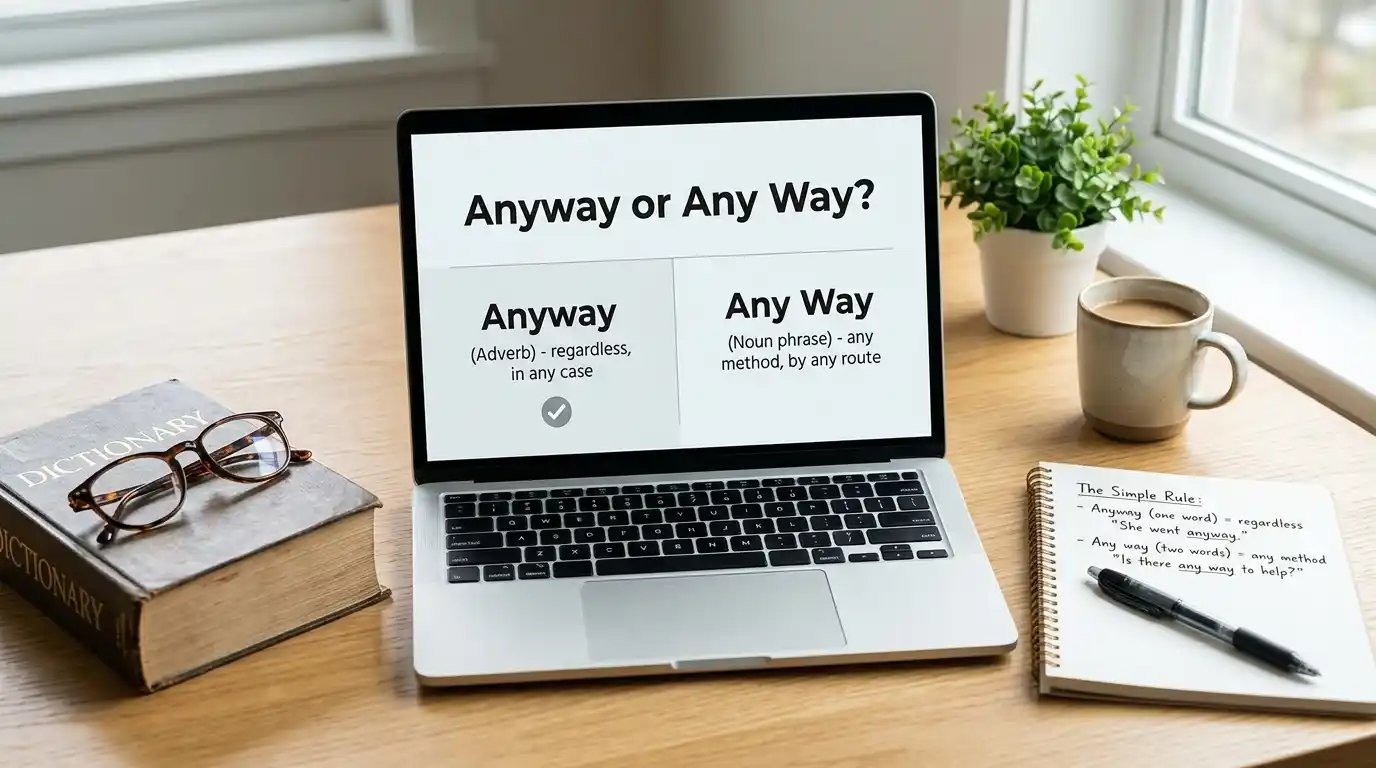
“Anyway” is one word. It is an adverb. Use it to mean “regardless” or “in any case.”
- Example: I was tired, but I went to the gym anyway.
“Any way” is two words. It means “any method” or “any manner.” You usually see it before “that” or “to.”
- Example: Is there any way to fix this printer?
A simple test: if you can swap the phrase with “somehow” or “regardless,” use anyway. If you can swap it with “any method” or “any path,” use any way.
- I don’t like rain, but I’ll go anyway. (regardless)
- Is there any way we can leave early? (any method)
That’s the core rule. The rest of this guide explains why the confusion exists and how to avoid every trap.
The Origin of Anyway
The word “anyway” comes from Old English. It formed by joining “any” and “way,” much like other compound adverbs such as “somehow” or “somewhat.” Over centuries, the two words fused into one because people used the phrase so often as a single idea: “in any case.”
“Any way,” on the other hand, kept its two-word form because it still functions as an adjective (“any”) describing a noun (“way”). It never lost its literal meaning of a path, method, or manner.
This is a common pattern in English. Words that start as two separate words sometimes merge into one when they take on a new, more abstract meaning. “Anyway” followed this path. “Any way” stayed literal, so it stayed split.
Spelling differences also exist because English evolved differently across regions. Printers, dictionaries, and schools in different countries did not always agree on which compound words to merge first. This is part of why spelling habits still vary today, especially between American and British English.
British English vs American English Spelling
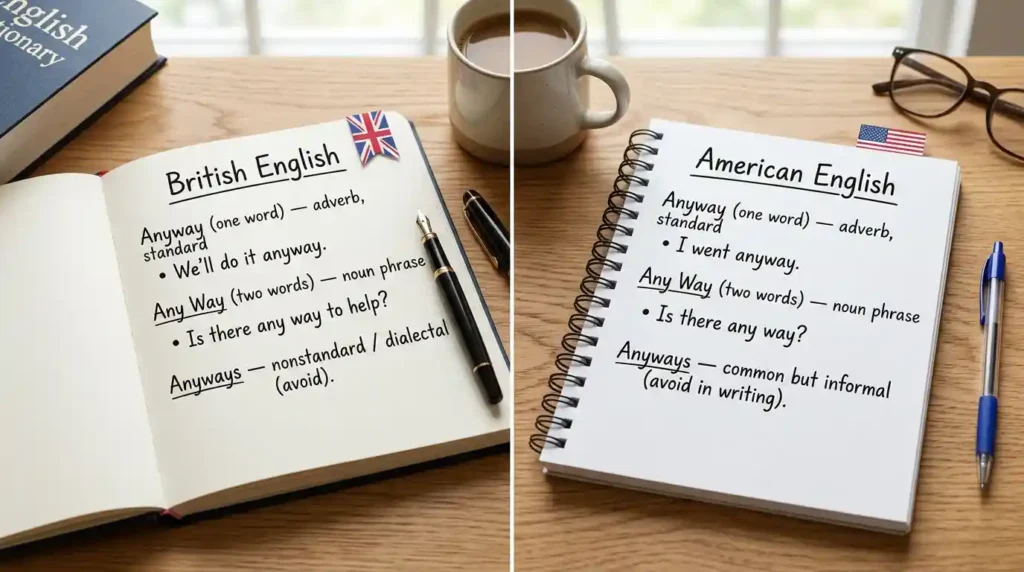
Good news: both British and American English treat “anyway” and “any way” the same way. The one-word versus two-word rule does not change across the pond.
However, there is one related point of confusion worth noting: the nonstandard form “anyways.” This form appears mostly in casual American speech. It is not considered correct in formal writing in either British or American English, though it is more common informally in the US and Canada.
| Form | British English | American English | Formal Writing |
| Anyway | Correct, standard | Correct, standard | Accepted |
| Any way | Correct, standard | Correct, standard | Accepted |
| Anyways | Rare, informal | More common, informal | Avoid |
So the real spelling choice is not about country. It is about meaning: are you saying “regardless” or “any method”?
Which Spelling Should You Use?
Your choice depends on meaning, not location. But here is guidance by audience.
For US readers: Use “anyway” for casual and formal writing when you mean “regardless.” Avoid “anyways” in emails, reports, and resumes. It reads as too informal.
For UK and Commonwealth readers (Canada, Australia, New Zealand, India): The same one-word versus two-word rule applies. “Anyways” is even less accepted here, so skip it in any professional context.
For global or ESL writers: Stick to the simple test. Ask yourself: does the sentence mean “regardless” or “a method”? This works no matter which English variety you are writing in.
For business and academic writing everywhere: Never use “anyways.” Always choose between “anyway” and “any way” based on meaning.
Common Mistakes with Anyway and Any Way
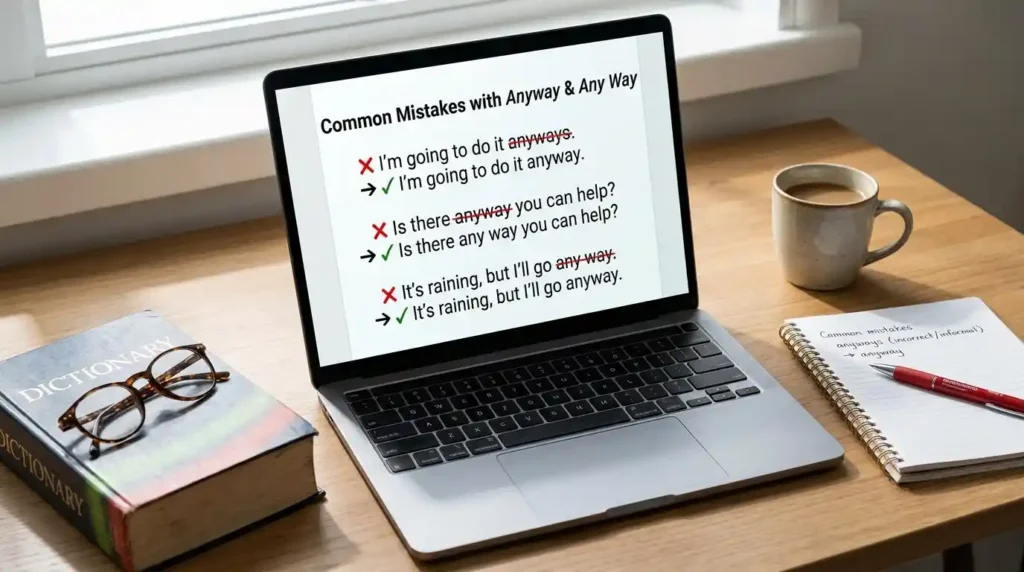
Here are the errors people make most often, with corrections.
- Mistake: Anyways, let’s move on. Fix: Anyway, let’s move on. (Drop the “s” in formal writing.)
- Mistake: There is no anyway to solve this. Fix: There is no way to solve this. Or: There is no way at all to solve this. (“Any way” needs a positive or question context, not “no.”)
- Mistake: Is there anyway I can help? Fix: Is there any way I can help? (You mean “any method,” so it stays two words.)
- Mistake: I’ll finish the report any way. Fix: I’ll finish the report anyway. (You mean “regardless,” so it becomes one word.)
- Mistake: Any way, let’s start the meeting. Fix: Anyway, let’s start the meeting. (Starting a new topic always uses one word.)
The pattern is clear: check the meaning first, then pick the spelling.
Anyway in Everyday Examples
In emails: Thanks for your patience. Anyway, I wanted to update you on the project timeline.
In news writing: The company denied the claims. Analysts, anyway, remain skeptical about future growth.
In social media: lol anyway here’s a photo of my dog 🐶
In formal writing: The results were inconclusive. The research team proceeded with the trial anyway, citing early promising signs.
Using “any way” in context: Please let us know if there is any way we can improve our service.
Formal: The committee found no lawful way to proceed without additional funding.
Notice how “anyway” often signals a shift in topic or a contrast. “Any way” almost always pairs with a question or a request.
Anyway Google Trends & Usage Data

Search interest in “anyway vs any way” stays steady year-round, with small spikes tied to back-to-school seasons and grammar-check tool usage. The keyword performs well across English-speaking countries, with the United States, the United Kingdom, India, and the Philippines showing the highest search volume.
“Anyways” also gets searched often, mostly by people checking If it is a real word (it is used informally, but many style guides discourage it in writing). This tells us the confusion is less about British versus American English and more about basic word-boundary and grammar uncertainty.
Voice search and mobile typing have increased searches for this term, since autocorrect sometimes merges or splits the words incorrectly, prompting users to double-check.
Comparison Table Keyword Variations
| Term | Word Count | Meaning | Correct Usage |
| Anyway | One word | Regardless, in any case | I’ll go anyway. |
| Any way | Two words | Any method or manner | Is there any way to help? |
| Anyways | One word (informal) | Same as “anyway” | Avoid in formal writing |
| Any ways | Two words (rare, incorrect) | Not standard | Avoid entirely |
FAQs
Is “anyway” one word or two?
“Anyway” is always one word when it means “regardless” or “in any case.”
Is “anyways” a real word?
Yes, but it is informal. Avoid it in professional or academic writing. Use “anyway” instead.
When do I use “any way” as two words?
Use it when you mean “any method” or “any manner,” often before “to” or “that.”
Is “anyway” British or American English?
Both varieties use “anyway” the same way. The informal “anyways” is more common in American speech.
Can “anyway” start a sentence?
Yes. It is common and correct to start a sentence with “anyway” to change topics, especially in speech and casual writing.
Is “no anyway” correct?
No. Say “no way” instead. “Anyway” does not combine correctly with “no” in that sense.
What is a quick trick to remember the difference?
If you can replace the word with “regardless,” use “anyway.” If you can replace it with “a method,” use “any way.”
Conclusion
The choice between “anyway” and “any way” comes down to one question: are you talking about a method, or are you saying “regardless”? Once you know the meaning you intend, the spelling follows naturally.
Remember these key points. “Anyway” is one word and means “in any case” or “regardless.” “Any way” is two words and means “any method” or “manner.” “Anyways” is informal and should be avoided in professional writing. This rule holds true across British, American, and global English, since the difference is about meaning, not region.
Next time you pause while typing, run the quick test. Swap in “regardless” or “a method” and see which one fits. Your sentence will tell you the answer.
With this guide, you now have a clear, simple system. Use it in emails, essays, and everyday messages. You will never second-guess this word again.

I’m Raheela Rani, a professional content writer and author with 3 years of experience in writing, editing, and storytelling. Through VisitLivo.com, I create clear, engaging, and well-crafted content that helps readers learn, connect, and communicate with confidence.