Ever typed a word and then stopped? Your fingers hover. Is it whiney or whiny? You are not alone. Many people ask this every month. The word looks simple, but the spelling feels tricky. Some words drop the silent E before -y. Others keep it. That mixed pattern causes doubt.
People search this keyword for one reason. They want the right spelling, and they want it fast. You could be replying to a client, posting on Instagram, or finishing homework. Either way, you need the right word now. You do not want a red line under your word.
This article clears up the confusion. You will get a quick answer first. Then you will learn where the word comes from. You will see how British and American English handle it. You will also see common mistakes, real examples, and a list of FAQs. By the end, you will know which spelling to use and why. Let us settle it.
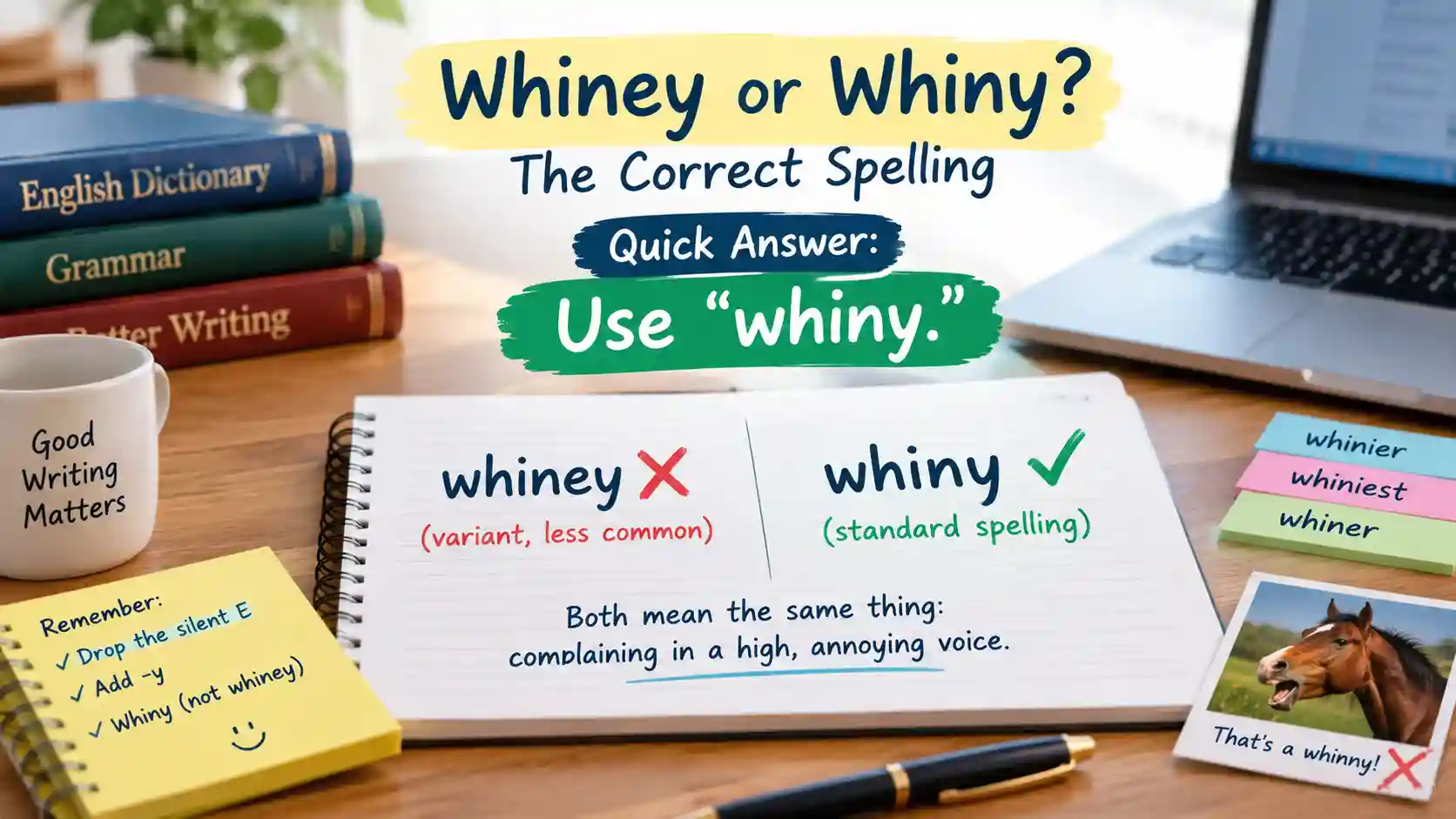
Whiney or Whiny Quick Answer
Use “whiny.” It is the standard spelling in American and British English. Major dictionaries list it first.
“Whiney” is a variant. Some dictionaries list it as an alternate form. But it is less common, and many editors will mark it as an error.
Both mean the same thing: complaining in a high, annoying voice.
- The whiny toddler wanted a cookie.
- I am tired of his whiny tone.
If you are unsure, pick “whiny.” You will be right in almost every case.
The Origin of Whiny

The word starts with “whine.” In Old English, the verb hwīnan meant to make a high, thin sound. It described wind whistling or something whizzing through the air. Over time, it came to mean a sad, complaining cry.
Later, English speakers added “-y” to make an adjective. This is a common trick. Add -y to “noise” and you get “noisy.” Add it to “whine” and you get “whiny.”
So why do two spellings exist? Because of the silent E. The verb “whine” ends in E. When you add -y, the usual rule says to drop the E. That gives “whiny.” But some writers keep the E because it feels safer. That gives “whiney.” English spelling has never been fully tidy, so both forms showed up.
British English vs American English Spelling

Here is the good news. British and American English agree on this one. Both prefer “whiny.”
The big spelling gaps between the two (like color and colour) do not apply here. “Whiney” is a rare variant in both places, not a British or American choice.
| Feature | American English | British English |
| Preferred spelling | whiny | whiny |
| Variant spelling | whiney (rare) | whiney (rare) |
| Comparative | whinier | whinier |
| Superlative | whiniest | whiniest |
| Noun form | whiner | whiner |
The silent E rule helps here. When a word ends in a silent E, drop it before adding -y.
| Base Word | With -y |
| noise | noisy |
| shine | shiny |
| bone | bony |
| whine | whiny |
A few words break the rule. Some words keep the E or allow both forms, such as cagey/cagy, homey/homy, and phoney/phony. This is why “whiney” looks tempting. But for “whine,” the dropped-E form is the standard one.
Which Spelling Should You Use?
For US readers: Use “whiny.” American dictionaries list it as the main form.
For UK and Commonwealth readers: Use “whiny.” British dictionaries do the same. This includes readers in Australia, Canada, India, and South Africa.
For a global audience: Use “whiny.” It is safe everywhere.
For school, work, and formal writing: Use “whiny.” Editors and teachers expect it.
When could “whiney” be fine? If you are quoting someone who wrote it that way, keep their spelling. Also, follow your company style guide if it says otherwise. Outside of that, skip it.
Simple rule: when in doubt, drop the E.
Common Mistakes with Whiny
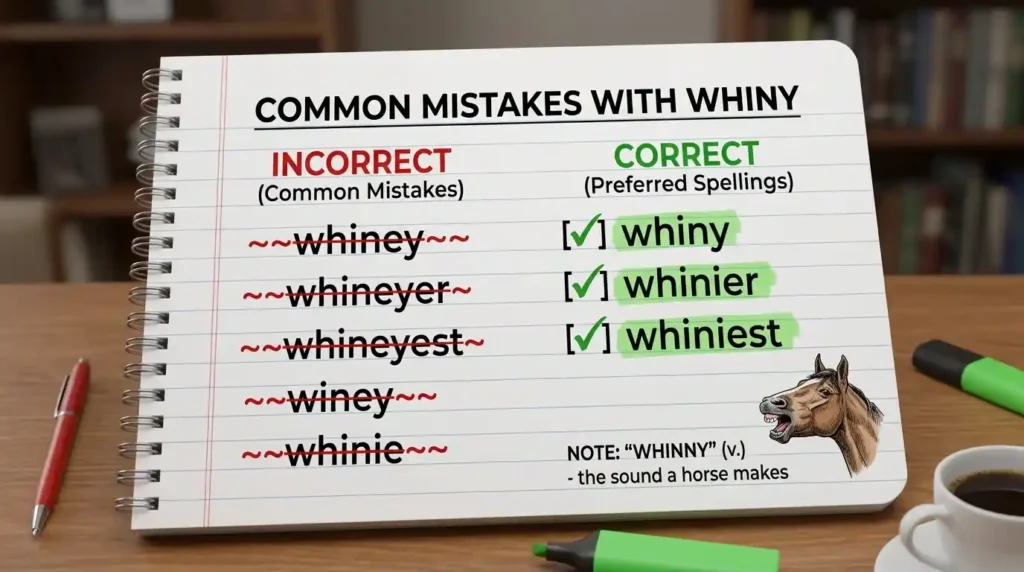
Here are the errors people make most.
1. Using “whiney” in formal writing.
- Wrong: The whiney customer called again.
- Right: The whiny customer called again.
2. Mixing it up with “whinny.” A “whinny” is the soft sound a horse makes. It is a different word.
- Wrong: The horse was whiny in the barn.
- Right: The horse whinnied in the barn.
3. Misspelling the forms.
- Wrong: whineyer, whineyest
- Right: whinier, whiniest
4. Typing “winey” or “whinie.” These are typos. “Winey” means like wine.
5. Confusing “whiner” and “whiny.” “Whiner” is a person. “Whiny” describes the person.
- He is a whiner.
- He is whiny.
Whiny in Everyday Examples

In emails:
- Sorry if I sounded whiny in my last message.
- I do not mean to be whiny, but the report is late again.
In news headlines:
- Whiny Fans Flood Comment Section After Game
- Why Some Voters Sound Whiny to Others
On social media:
- My kid is being so whiny today. Send coffee.
- I hate when I get whiny when I’m hungry.
In formal writing:
- The critic called the novel’s narrator whiny and self-focused.
- Whiny behavior in young children is often linked to tiredness.
Notice the tone in each one. “Whiny” is usually a mild insult. Use it with care in work settings.
Whiny Google Trends and Usage Data
I cannot pull live Google Trends numbers here, and I will not invent them. But the general pattern is clear, and you can confirm it yourself in minutes.
What you will likely see:
- “Whiny” is searched far more than “whiney” in most countries.
- Searches for “whiney” tend to come from people checking the spelling. They often type “whiney or whiny” to be sure.
- The United States, United Kingdom, Canada, and Australia are common places for these searches.
- Interest often rises around parenting topics, sports commentary, and social media debates.
How to check it yourself:
- Go to Google Trends.
- Type “whiny” and add “whiney” as a comparison.
- Change the region to see country differences.
Dictionary and news usage tell the same story. “Whiny” wins by a wide margin.
Keyword Variations Side by Side
| Word | Meaning | Correct? |
| whiny | Complaining in an annoying way | Yes, standard |
| whiney | Same meaning | Variant, less common |
| whinier / whiniest | Comparative and superlative | Yes |
| whiner | A person who whines | Yes |
| whinny | The sound a horse makes | Yes, but a different word |
| winey | Tasting like wine | Yes, but a different word |
| whineyer / whineyest | Attempted comparative | No |
FAQs
Is it whiney or whiny?
“Whiny” is the standard spelling. “Whiney” is a less common variant.
Is “whiney” a real word?
Some dictionaries list it as an alternate spelling. But most writers and editors prefer “whiny.”
Is “whiny” British or American?
Both. It is the preferred form in the US and the UK.
What is the comparative form of whiny?
“Whinier.” The superlative is “whiniest.”
What is the difference between whiny and whinny?
“Whiny” describes someone who complains in a high voice. “Whinny” is the soft neighing sound of a horse.
Why do some people spell it “whiney”?
They keep the silent E from “whine.” It feels natural, even though the standard rule drops it.
Is “whiny” rude to say?
It can be. It is a mild insult. Avoid it in professional messages unless you have a good reason.
What is a good synonym for whiny?
Try “complaining,” “fussy,” “cranky,” or “grumbling.”
Conclusion
Let us wrap it up. The answer is simple: use “whiny.” It is the standard spelling in both American and British English. It works for emails, essays, news, and social posts. Dictionaries back it up, and editors expect it.
“Whiney” does exist as a variant. But it is less common, and many readers will see it as a mistake. Unless you are quoting someone or following a special style guide, skip it.
Remember the silent E rule. When a word ends in a silent E, drop it before adding -y. That is why we have noisy, shiny, bony, and whiny. Also watch out for look-alike words. A “whinny” belongs to a horse. “Winey” belongs to a glass of wine.
Finally, keep your forms straight: whiny, whinier, whiniest. And use “whiner” for the person.
Next time you feel stuck, drop the E and move on. Your writing will look clean and professional.

I’m Raheela Rani, a professional content writer and author with 3 years of experience in writing, editing, and storytelling. Through VisitLivo.com, I create clear, engaging, and well-crafted content that helps readers learn, connect, and communicate with confidence.