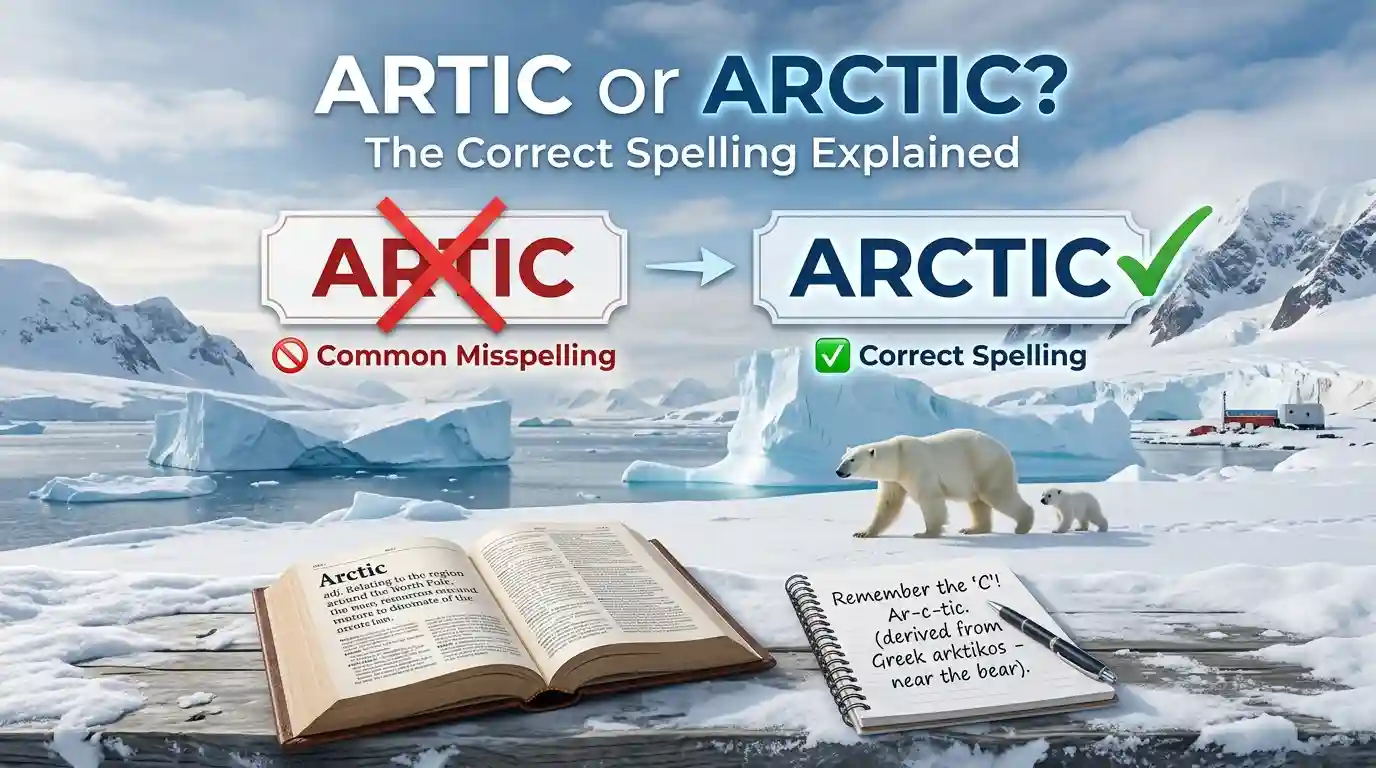
You are writing about polar bears, ice, or cold weather. Then you stop. Is it “artic” or “arctic”? Both look odd. You are not alone. Millions of people pause on this word.
The word is hard because of how we say it. Many people say “ARK-tik.” Many others say “AR-tik.” In fast speech, the first c can vanish. So when we write, we skip it. Spell check does not always catch the mistake, and search engines see a lot of searches for the wrong spelling.
This article gives you the answer fast. By the end, you will know the right spelling and where the word comes from. You will see why so many people get it wrong. We will also show how British and American English compare, and which spelling to use in emails, news, and school work.
The short answer: the correct spelling is arctic, with two c’s. There is one small twist with “artic” that we will cover too. Let’s clear this up for good.
Artic or Arctic Quick Answer
Arctic is correct. It has a c after the r and a c at the end: A-R-C-T-I-C.
Use it for the cold region around the North Pole, and for anything very cold.
- The Arctic Ocean is icy all year.
- We saw an arctic fox in the snow.
- An arctic wind blew through town last night.
“Artic” is a misspelling in almost every case. The one exception is British slang. In the UK, “artic” is short for “articulated lorry,” a big truck with a bendy middle. (“An artic blocked the road.”) That is a different word with a different meaning. It has nothing to do with ice.
Capital letter tip: Write “the Arctic” with a capital A when you mean the region. Write “arctic” in lowercase when you mean “very cold,” as in “arctic weather.”
The Origin of Arctic
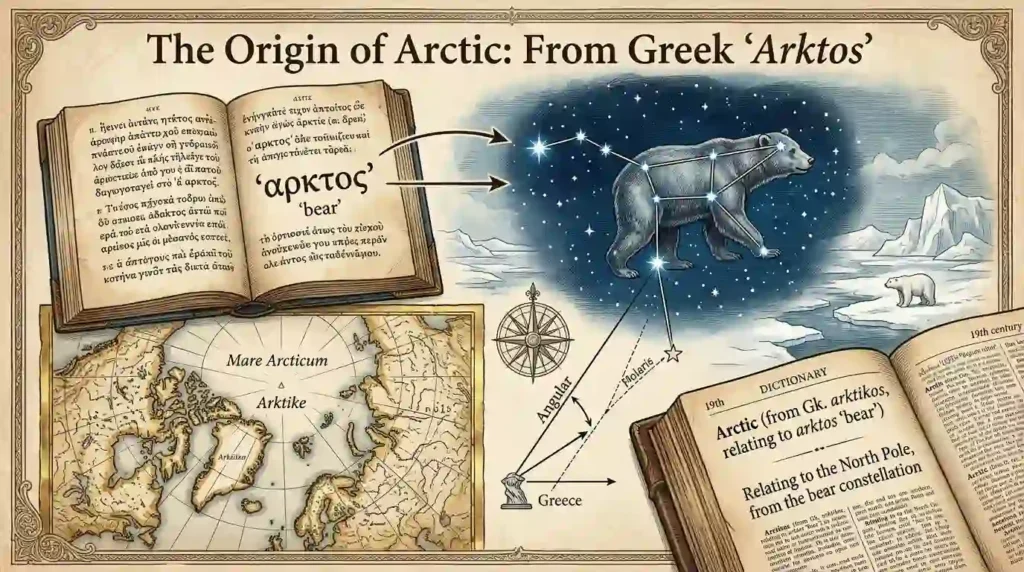
The word has an old story. It starts with the Greeks. Their word arktos meant “bear.” The Greeks saw a group of stars in the northern sky that looked like a bear. We now call it the Great Bear, or Ursa Major. Those stars stay above the north horizon. So the Greeks used arktikos to mean “of the north,” or “near the bear.”
Then the word moved into Latin as arcticus. Later it came into Old French. In French and early English, the word was often written without the first c. It looked like artique or artik. That matched how people said it.
Then something changed. Scholars wanted English spellings to match the Latin and Greek roots. So they put the c back. But people kept saying the word without it.
That is why the spelling and the sound do not match today. The c is in the spelling because of history. It is not there because of sound.
The word “Antarctic” has the same story. It means “opposite the Arctic,” from the Greek anti (against) and arktikos. People drop the first c there, too, and say “Antartic.” The right spelling is Antarctic.
British English vs American English Spelling
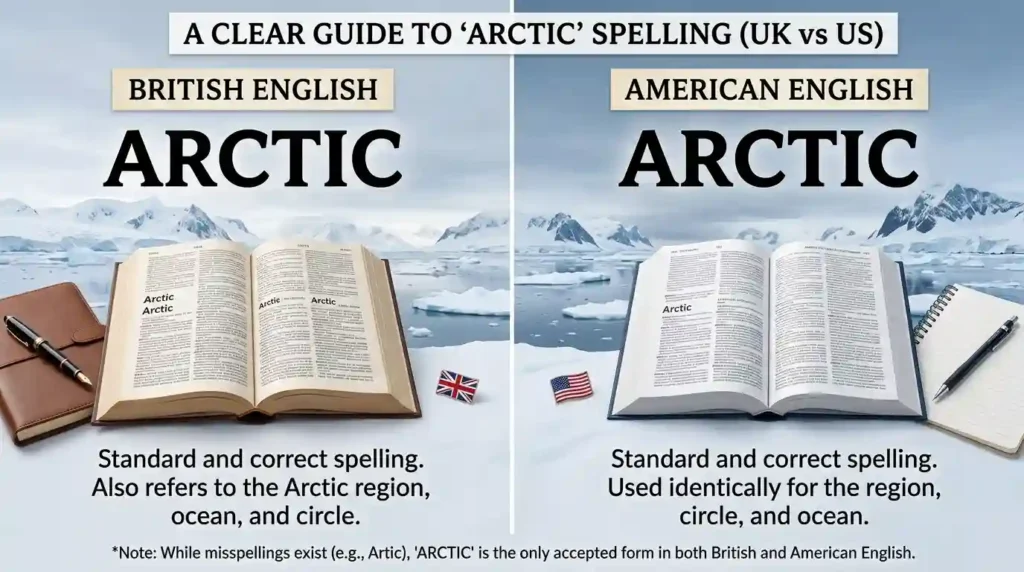
Here is the good news. There is no British or American difference for this word. Both use “arctic.” Many words do differ, like color and colour. This one does not.
| Word | American English | British English | Notes |
| The cold region | Arctic | Arctic | Same everywhere |
| Very cold (adjective) | arctic | arctic | Same everywhere |
| Opposite pole | Antarctic | Antarctic | Same everywhere |
| Big truck (slang) | Not used | artic | UK informal, short for “articulated lorry” |
| Common misspelling | artic | artic | Wrong in both |
So if you see “artic” in a US text, it is a typo. If you see it in a UK text, it may be a typo, or it may be truck slang. Check the meaning.
Which Spelling Should You Use?
Use arctic. This is true almost everywhere. Here is how to think about it by reader.
- US readers: Write “arctic” or “Arctic.” Never use “artic.”
- UK and Commonwealth readers (Canada, Australia, India, Pakistan): Same spelling. Only use “artic” if you truly mean a truck, and only in casual writing.
- Global readers: Use “arctic.” It is the standard form in dictionaries, science, news, and schools around the world.
- Business and formal writing: Always “arctic,” and check the capital letter.
If you are unsure, spell it out slowly: A-R-C-T-I-C. Say “ark-tic” in your head as you write. That helps you remember the first c.
Common Mistakes with Arctic
| Mistake | Correct | Why it happens |
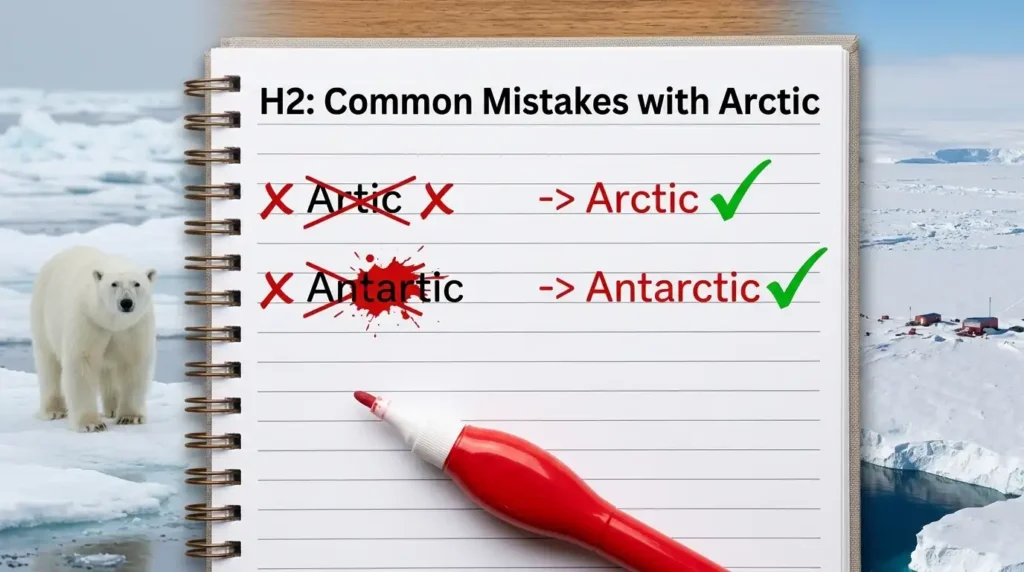
| Artic | Arctic | The first c is silent in speech |
| Antartic | Antarctic | Same missing c |
| Artic Ocean | Arctic Ocean | Typing by sound |
| arctic circle | Arctic Circle | Proper name needs capitals |
| Arctic (for a warm place) | n/a | Wrong meaning: arctic means very cold |
| Arctic fox vs. artic fox | Arctic fox | Same spelling error |
Quick fixes:
- Check for two c’s: one in the middle, one at the end.
- Capitalize it when it names the region or a place name (the Arctic Circle).
- Use lowercase for the “very cold” meaning.
- Do not confuse it with “Antarctic,” which is the South Pole region.
Arctic in Everyday Examples
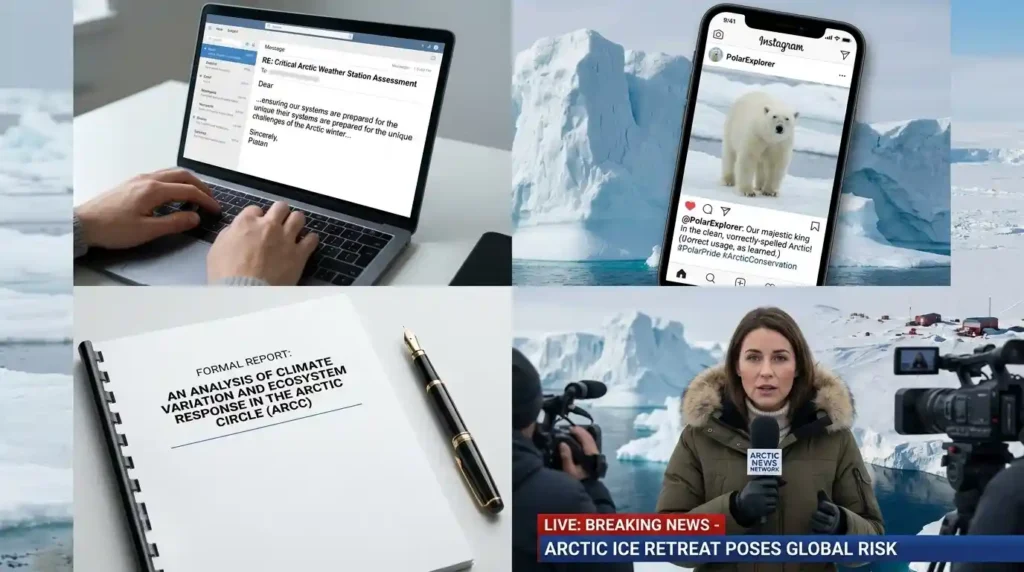
Email:
“Please bring a warm coat. The office feels arctic today.”
“Our team is working on the Arctic climate report.”
News:
“Scientists say the Arctic is warming faster than the rest of the planet.”
“An arctic blast will bring snow to the north this week.”
Social media:
“Woke up to arctic temps. Send coffee. ☕”
“Just saw an Arctic fox photo. So cute!”
Formal writing:
“The Arctic Circle marks the edge of the polar region.”
“Arctic sea ice has declined over the past decades.”
UK slang (the truck meaning):
“There was an artic stuck on the bridge.”
Arctic Google Trends & Usage Data
I cannot pull live numbers here, so I will not make up figures. You can check the exact data yourself for free at Google Trends. Here is what usually shows up for words like this.
- Both spellings get searched. “Arctic” is far more common. “Artic” appears because many people type by sound.
- Winter spikes. Searches often rise in colder months and during cold snaps.
- News spikes. Interest jumps with stories on climate, melting ice, polar expeditions, and wildlife.
- Names add traffic. People also search “Arctic” for the band Arctic Monkeys, the Arctic Circle, and Arctic Ocean.
- Country patterns. Searches for the misspelling are likely to show in English-speaking countries such as the US, UK, Canada, Australia, India, and Pakistan. The UK may also show extra “artic” searches for the truck meaning.
Tip: In Google Trends, type both “artic” and “arctic” and compare them. Then filter by country and by time.
Side-by-Side Comparison
| Term | Correct? | Meaning | Typical use |
| Arctic | ✅ Yes | North polar region | Science, news, geography |
| arctic (lowercase) | ✅ Yes | Very cold | Weather, describing cold |
| Artic | ❌ No (usually) | Misspelling | Typos |
| artic (UK slang) | ⚠️ Only in the UK, informal | Articulated lorry | Casual talk about trucks |
| Antarctic | ✅ Yes | South polar region | Science, geography |
| Antartic | ❌ No | Misspelling | Typos |
FAQs
Is it “artic” or “arctic”?
It is “arctic.” Two c’s. “Artic” is a common misspelling.
Why do people leave out the first c?
Because they often do not say it. “AR-tik” is a common way to say the word. People write what they hear.
Is “artic” ever correct?
Only in UK slang. There, “artic” means an articulated lorry, a large truck. It has nothing to do with cold or ice.
Is “arctic” spelled differently in British and American English?
No. Both use “arctic.” The spelling is the same worldwide.
Do I capitalize “Arctic”?
Yes, when it names the region or a place: the Arctic, the Arctic Ocean, the Arctic Circle. Use lowercase for the “very cold” meaning: “arctic weather.”
What is the difference between Arctic and Antarctic?
The Arctic is at the North Pole. The Antarctic is at the South Pole. The Arctic is mostly ocean with ice. The Antarctic is a large continent.
Where does the word “arctic” come from?
It comes from the Greek word arktos, meaning “bear.” It refers to the Great Bear star group in the northern sky.
How can I remember the spelling?
Think “ARC-tic.” Say the c out loud in your head each time you write it.
Conclusion
So, artic or arctic? The answer is simple: arctic. It has two c’s, and that is true in both British and American English. There is no regional difference to worry about.
People make the mistake because of sound. Many of us do not say the first c. But the spelling keeps it because of the word’s Greek and Latin roots, which mean “bear” and point to the northern stars.
Here is what to remember:
- Write arctic for “very cold.”
- Write Arctic for the North Pole region and place names.
- Write Antarctic for the South Pole region.
- Use “artic” only in casual UK talk about trucks.
- Spell it slowly in your head: A-R-C-T-I-C.
If you write for a global audience, always choose “arctic.” It is correct in schools, news, science, and business. Before you hit send, take two seconds to check that word. It is a small step that makes your writing look sharp and trusted.

“I’m Ibadat Fatima, a professional content writer and author with 3 years of experience in writing, editing, and storytelling. I share my work through visitlivo.com, where I help readers connect with clear, engaging, and well-crafted content.”