You are writing a text. You type “I walked threw the park” and something feels off. Is it “threw” or “through”? You are not alone. Thousands of people search this exact question every month. These two words sound almost the same when spoken fast, but they mean completely different things.
The confusion happens for a simple reason: English is full of words that sound alike but are spelled differently and used differently. “Threw” and “through” are a classic example. One is a past-tense verb. The other is a preposition. Mixing them up is an easy, common mistake even for native speakers.
This guide gives you a fast answer first, then digs into the details. You will learn what each word means, where they come from, how to use them correctly, and which mistakes to avoid. By the end, you will never second-guess this pair again.
Threw or Through Quick Answer
Here is the short version:
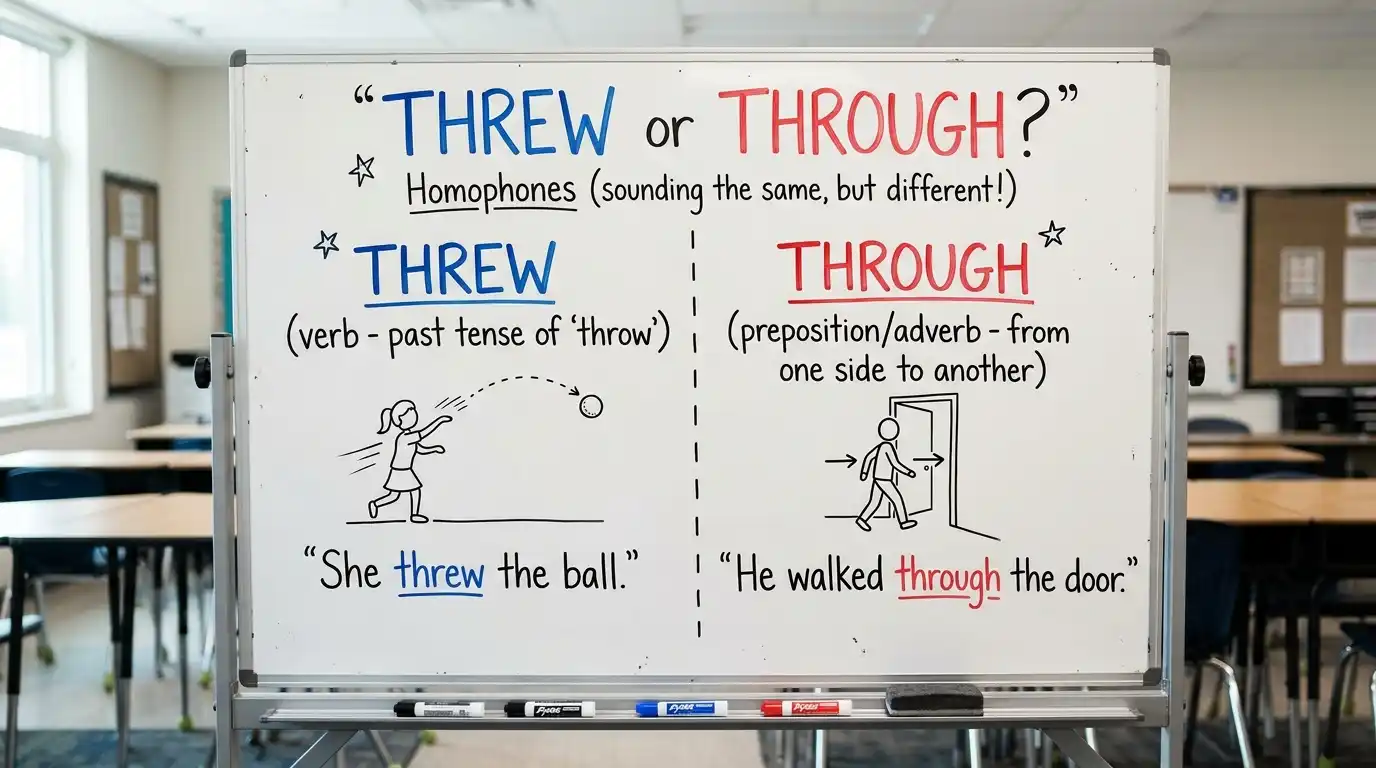
- Threw is the past tense of the verb “throw.” Use it when someone threw an object in the past.
- Example: She threw the ball across the yard.
- Through is a preposition or adverb. It means moving from one side of something to the other, or finishing something.
- Example: He walked through the door.
- Example: We are through with the project.
Quick test: if you can replace the word with “did throw,” use threw. If the sentence is about movement, direction, or completion, use through.
The Origin of Threw and Through

Both words trace back to Old English, and both come from the same root idea of movement or force.
Threw comes from the Old English verb thrawan, meaning to twist or turn, which later evolved into “throw.” Its past tense form, “threw,” followed the irregular verb pattern common in Germanic languages, similar to “grew” (grow) or “flew” (fly).
Through comes from the Old English word thurh, meaning “from end to end” or “by way of.” It has kept a similar spelling and meaning for over a thousand years, though its pronunciation has shifted over time.
Because both words share a Germanic root and similar-sounding letters, English speakers often blend them together in casual speech, which is where the spelling confusion begins.
British English vs American English Spelling
Here is something important to clear up: threw and through are not regional spelling variants. Unlike words such as “colour/color” or “favourite/favorite,” there is no British-versus-American version of these two words. Both are spelled and used the same way in the UK, the US, Canada, Australia, and everywhere else English is spoken.
The real spelling issue people run into is different: many writers shorten “through” to “thru” in casual texting or informal signage (like “drive-thru”). This shortened form is common in American informal writing but is considered nonstandard everywhere, including in the US, for formal writing.
| Word/Form | US English | UK English | Formal Writing | Informal/Casual Use |
| Threw | threw | threw | ✅ Correct | ✅ Correct |
| Through | through | through | ✅ Correct | ✅ Correct |
| Thru | Used casually | Rarely used | ❌ Avoid | ✅ Common (texts, signs) |
| Throughout | throughout | throughout | ✅ Correct | ✅ Correct |
Which Spelling Should You Use?
Since “threw” and “through” are different words with different jobs, the real question is not about spelling it’s about grammar and context.
- If you are a student or professional writer (US, UK, or anywhere): Always spell out “through” in full. Never use “thru” in essays, emails, reports, or resumes.
- If you are writing for social media or texting: “Thru” is acceptable and widely understood, but “through” still reads as more polished.
- If you are unsure which word fits your sentence: Ask if the action already happened (use “threw”) or if you are describing movement, direction, or completion (use “through”).
- For global audiences: Stick with full spellings. “Through” and “threw” are universally recognized, while “thru” can look careless in professional or international communication.
Common Mistakes with Threw and Through
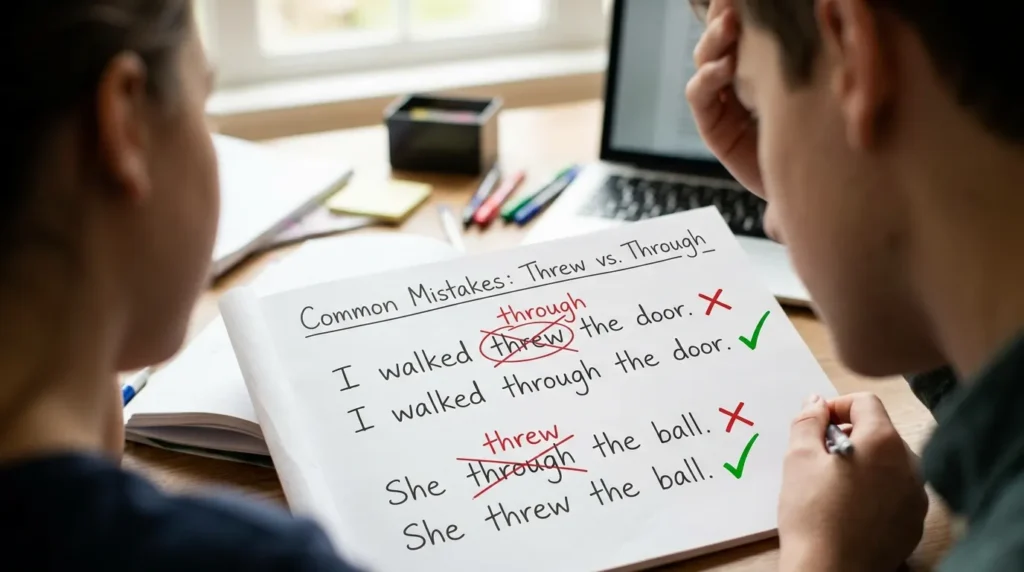
Here are the errors people make most often, and how to fix them:
- Mistake: “I walked threw the door.” Fix: “I walked through the door.” (Movement needs “through.”)
- Mistake: “She through the ball to her friend.” Fix: “She threw the ball to her friend.” (Past-tense action needs “threw.”)
- Mistake: Using “through” when you mean “thorough.” Fix: “Thorough” means detailed or complete (a thorough review). “Through” means passing from one side to another.
- Mistake: Overusing “thru” in professional writing. Fix: Spell out “through” in emails, reports, and formal documents.
- Mistake: Confusing “threw” with “throw.” Fix: “Throw” is present tense (“I throw the ball now”). “Threw” is past tense (“I threw the ball yesterday”).
Threw and Through in Everyday Examples
- Emails: “We went through the report line by line before sending it.”
- News writing: “The storm tore through the coastal town, damaging dozens of homes.”
- Social media posts: “Just threw together a quick dinner and it turned out amazing 🍝”
- Formal writing: “The committee threw its support behind the new policy after reviewing it through several drafts.”
Notice the pattern: “through” usually points to movement, a process, or something reaching completion, while “threw” always marks a finished action something that happened and is done.
Threw or Through Google Trends & Usage Data

Search interest in “threw or through” spikes mainly among students, ESL learners, and writers double-checking grammar before submitting work. In general:
- English-speaking countries (US, UK, Canada, Australia) show steady, year-round search interest, largely driven by students and content writers.
- Non-native English-speaking regions show higher search volume, since these two words are frequently confused during translation and language learning.
- Searches often pair with related terms like “threw vs through,” “through vs threw grammar,” and “thru vs through,” showing that people are looking for quick clarification rather than deep linguistic study.
This pattern is common for homophone-like word pairs people search for a fast answer, not a lecture, which is why quick-reference guides like this one perform well.
Keyword Variation Comparison Table
| Variation | Meaning | Correct Usage | Common Context |
| Threw | Past tense of “throw” | She threw the keys to him. | Storytelling, past actions |
| Through | Moving across/finishing | He drove through the tunnel. | Directions, completion |
| Thru | Informal short form of “through” | Drive-thru window | Signs, texting |
| Throughout | During the entire time/space | It rained throughout the day. | Formal and casual writing |
| Thorough | Complete and detailed | A thorough investigation | Formal writing (often confused with “through”) |
Frequently Asked Questions
Is it “threw” or “through” the window?
It depends on the sentence. If something moved from one side to the other, use “through” (“The ball flew through the window”). If someone threw an object at the window, use “threw” (“He threw a rock at the window”).
Is “thru” a real word?
“Thru” is an informal, shortened spelling of “through.” It’s common in casual texting and on signs like “drive-thru,” but it’s not accepted in formal or academic writing.
What is the past tense of “throw”?
The past tense of “throw” is “threw.” Example: “I throw the ball every day” (present) becomes “I threw the ball yesterday” (past).
Is “through” past or present tense?
“Through” is not a verb, so it doesn’t have a tense. It’s a preposition or adverb describing movement, direction, or completion.
What’s the difference between “through” and “thorough”?
“Through” means passing from one side to another. “Thorough” means detailed and complete. They sound different but are commonly mixed up in writing.
Do British and American English spell “through” differently?
No. “Through” is spelled the same way in both British and American English. There is no regional spelling variant for this word.
Can “threw” and “through” ever be used in the same sentence correctly?
Yes. Example: “She threw the ball through the hoop.” Here, “threw” shows the action, and “through” shows the direction the ball traveled.
Conclusion
“Threw” and “through” are easy to confuse but simple to master once you know the difference. “Threw” is always a past-tense verb describing an action that already happened. “Through” is a preposition or adverb describing movement, direction, or completion. Unlike many word pairs, there is no British versus American spelling difference here both words are spelled identically worldwide. The real trap is casual shortcuts like “thru,” which are fine for texting but should be avoided in professional or academic writing.
Whenever you’re unsure, ask yourself: does the sentence describe someone throwing something in the past? Use “threw.” Does it describe movement, direction, or finishing something? Use “through.” With this simple test, you’ll spell it correctly every time, if you’re writing an email, a school essay, or a social media post.

“I’m Ibadat Fatima, a professional content writer and author with 3 years of experience in writing, editing, and storytelling. I share my work through visitlivo.com, where I help readers connect with clear, engaging, and well-crafted content.”