Ever paused mid-sentence, unsure if to write “skill set” or “skillset”? You’re not alone. This is one of the most common word-splitting questions in English writing today. People search for this because both versions show up everywhere in job postings, resumes, LinkedIn profiles, and business articles. Spell checkers don’t always agree. Style guides don’t always agree either. That’s the confusion.
The good news: both forms are widely understood. But context matters. Where you’re writing, who reads it, and how formal your tone is all affect which version fits best. This article gives you a fast answer, then digs into the details. You’ll learn the history behind the split, how British and American English treat it differently, and which version to use in resumes, emails, and everyday writing. By the end, you’ll never second-guess this word again.
Skill Set or Skillset Quick Answer
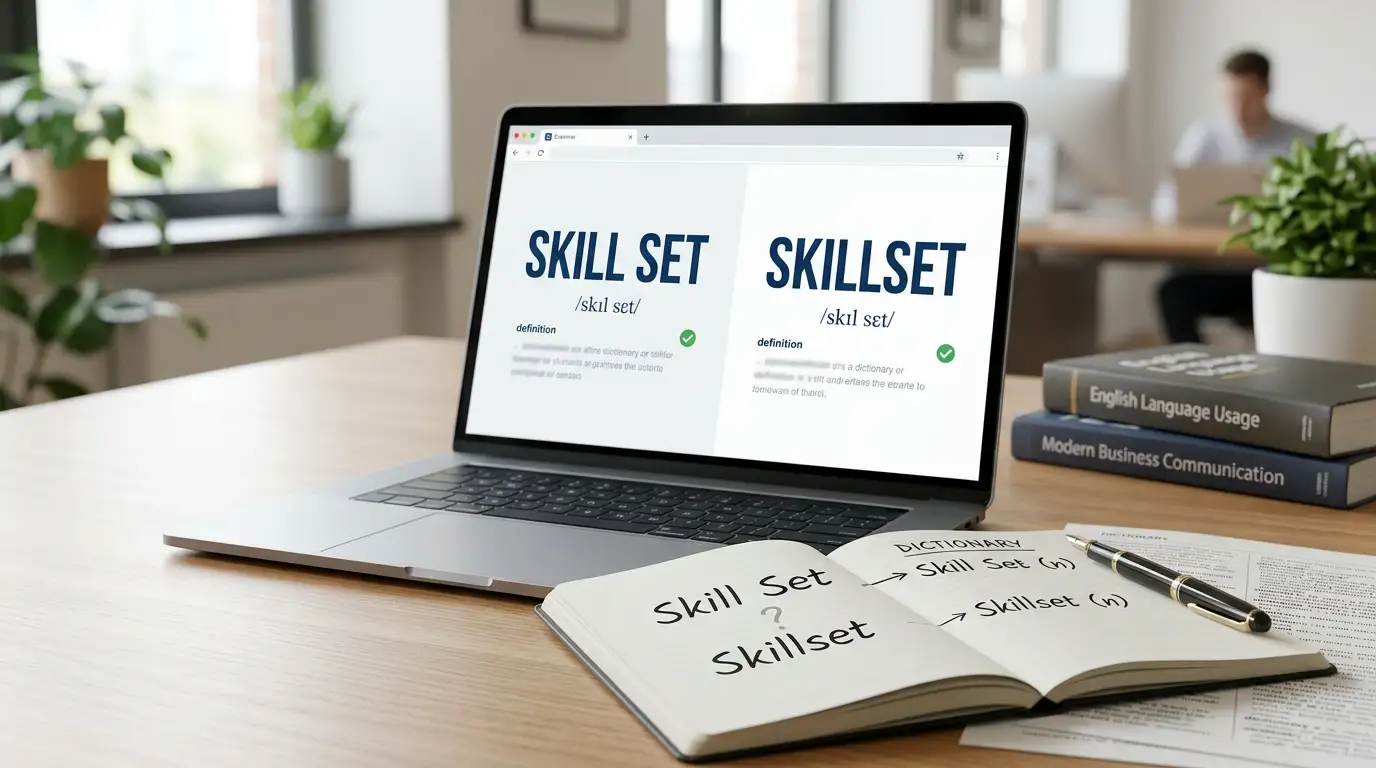
“Skill set” (two words) is the traditional and most widely accepted form. It’s correct in formal writing, resumes, and professional documents.
“Skillset” (one word) is a newer, increasingly common variant. It’s popular in casual writing, tech industries, and online content.
Examples:
- “Her skill set includes project management and data analysis.” (formal)
- “She has a great skillset for this role.” (casual)
Both are understood everywhere. Neither is “wrong” in a strict sense today. But if you want the safest, most professional choice, use skill set as two words.
The Origin of Skill Set

The phrase “skill set” started as a simple combination of two separate words: skill (an ability) and set (a collection or group). It described a group of related abilities a person had much like a “tool set” is a collection of tools.
This two-word form dates back to business and technical writing in the late 20th century. As English evolves, compound phrases often merge into single words over time. Think of how “email” started as “e-mail,” or how “website” used to be “web site.”
“Skillset” follows this same pattern. It’s a natural language shift. Frequent word pairs often fuse together as they become common in everyday speech. This is why you now see “skillset” appearing more often, especially in digital and tech spaces where language moves fast.
British English vs American English Spelling
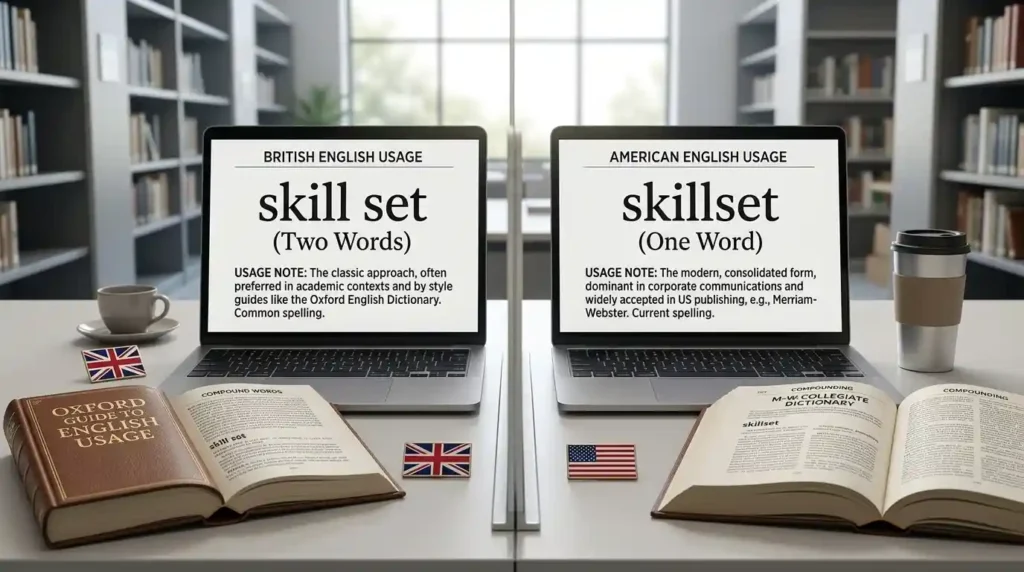
Neither British nor American English officially recognizes “skillset” as a standard dictionary word yet. Most major dictionaries including Oxford and Merriam-Webster still list “skill set” as two words.
However, usage patterns differ slightly by region and industry.
| Feature | Skill Set (Two Words) | Skillset (One Word) |
| Dictionary status | Standard, widely accepted | Informal, growing acceptance |
| Common in | Formal writing, print media | Tech industry, online content |
| British English | Preferred | Used informally |
| American English | Preferred | Used informally |
| Best for | Resumes, business documents | Casual blogs, social media |
Neither British nor American style guides show a strong regional preference. This isn’t like “colour” vs “color.” Instead, it’s a formality difference. The split comes from tone and industry, not geography.
Which Spelling Should You Use?
Here’s simple advice based on your audience:
For US and UK professional writing: Use “skill set” (two words). This is the safer, more traditional choice for resumes, cover letters, and formal reports.
For tech and startup culture: “Skillset” is common and accepted. Many tech companies and online platforms use it casually in blog posts and job listings.
For global or academic audiences: Stick with “skill set.” Academic style guides (APA, MLA, Chicago) favor the traditional two-word form.
For social media and casual content: Either works. “Skillset” often feels more modern and reads faster in short posts.
Rule of thumb: When in doubt, use two words. It’s the version dictionaries recognize, and it never looks incorrect.
Common Mistakes with Skill Set
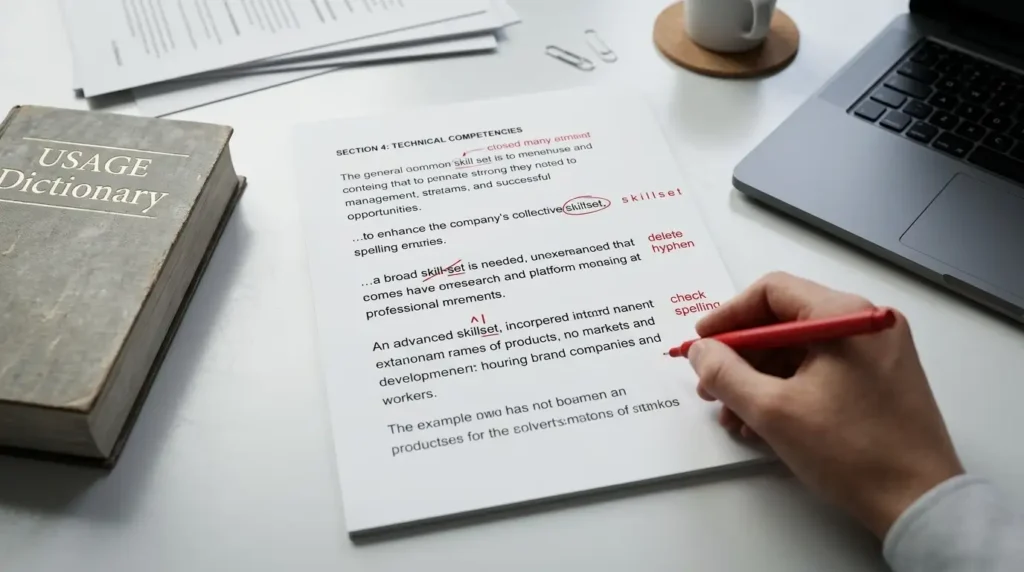
- Mixing spellings in the same document. Pick one version and stay consistent throughout.
- Using “skillsets” as the plural of “skillset.” This is grammatically awkward. “Skill sets” (two words, plural) reads more naturally.
- Confusing it with “skill sets” as separate items. “Skill set” refers to one collection of abilities, not individual skills listed separately.
- Assuming spell check confirms correctness. Many spell checkers accept both forms, so they won’t flag inconsistency.
- Using “skillset” in formal resumes. This can look less polished to traditional hiring managers or older institutions.
Skill Set in Everyday Examples
In emails:
“I believe my skill set aligns well with this position’s requirements.”
In social media posts:
“Leveling up my skillset one course at a time! 💪”
In formal writing:
“Candidates must demonstrate a diverse skill set, including leadership and technical proficiency.”
In job postings:
“We’re looking for someone with a strong skillset in marketing and analytics.”
Notice how formal contexts lean toward “skill set,” while casual and digital spaces often use “skillset.”
Skill Set Google Trends & Usage Data
Search data shows both terms are commonly searched, with “skill set” historically holding a slight edge in overall search volume. However, “skillset” has grown steadily, especially among younger audiences and in tech-related searches.
By country, US and UK searches show similar patterns both terms are used, with “skill set” still dominant in professional and educational content. Tech hubs and startup communities show higher usage of “skillset” as one word, reflecting how fast-moving industries often simplify language first.
Context matters more than country. Business and HR content favors “skill set.” Blogs, apps, and casual platforms favor “skillset.”
Keyword Variations Comparison
| Variation | Usage Context | Formality Level |
| Skill set | Resumes, reports, dictionaries | High |
| Skillset | Blogs, tech, social media | Medium-low |
| Skill sets (plural) | Multiple ability groups | High |
| Skillsets (plural) | Casual plural use | Low |
Frequently Asked Questions
Is “skillset” a real word?
It’s not yet in most major dictionaries as a standard entry, but it’s widely used and understood, especially in casual and tech writing.
What’s the plural of “skill set”?
“Skill sets” is the correct plural form when written as two words.
Should I use “skillset” on my resume?
No. Use “skill set” (two words) for resumes and formal job applications to appear more polished.
Is “skill set” one word or two?
Traditionally, it’s two words. “Skillset” as one word is a newer, informal variant.
Does British English spell it differently than American English?
No. Both regions generally prefer “skill set” as two words. The difference is formality, not geography.
Why do I see “skillset” so often online?
Language naturally simplifies over time, especially in fast-paced digital spaces like tech blogs and social media.
Can I use both spellings in the same document?
No. Pick one version and use it consistently throughout your writing for a professional, polished look.
Conclusion
“Skill set” and “skillset” both describe the same idea: a person’s collection of abilities and expertise. The two-word form, “skill set,” remains the traditional, dictionary-approved choice and works best in formal writing, resumes, and professional documents. “Skillset,” the one-word version, has grown popular in casual and tech-focused content, reflecting how language evolves over time.
Neither version is wrong. But context shapes the right choice. For job applications, academic work, and business communication, stick with “skill set.” For blogs, social media, and casual industry content, “skillset” works fine and feels modern.
The most important rule is consistency. Choose one spelling and use it throughout your document. This shows attention to detail and keeps your writing polished. When unsure, default to “skill set” it’s the safer, more universally accepted choice across every dictionary and style guide.
Now you know exactly which version fits your writing, your audience, and your goals.

I’m Raheela Rani, a professional content writer and author with 3 years of experience in writing, editing, and storytelling. Through VisitLivo.com, I create clear, engaging, and well-crafted content that helps readers learn, connect, and communicate with confidence.