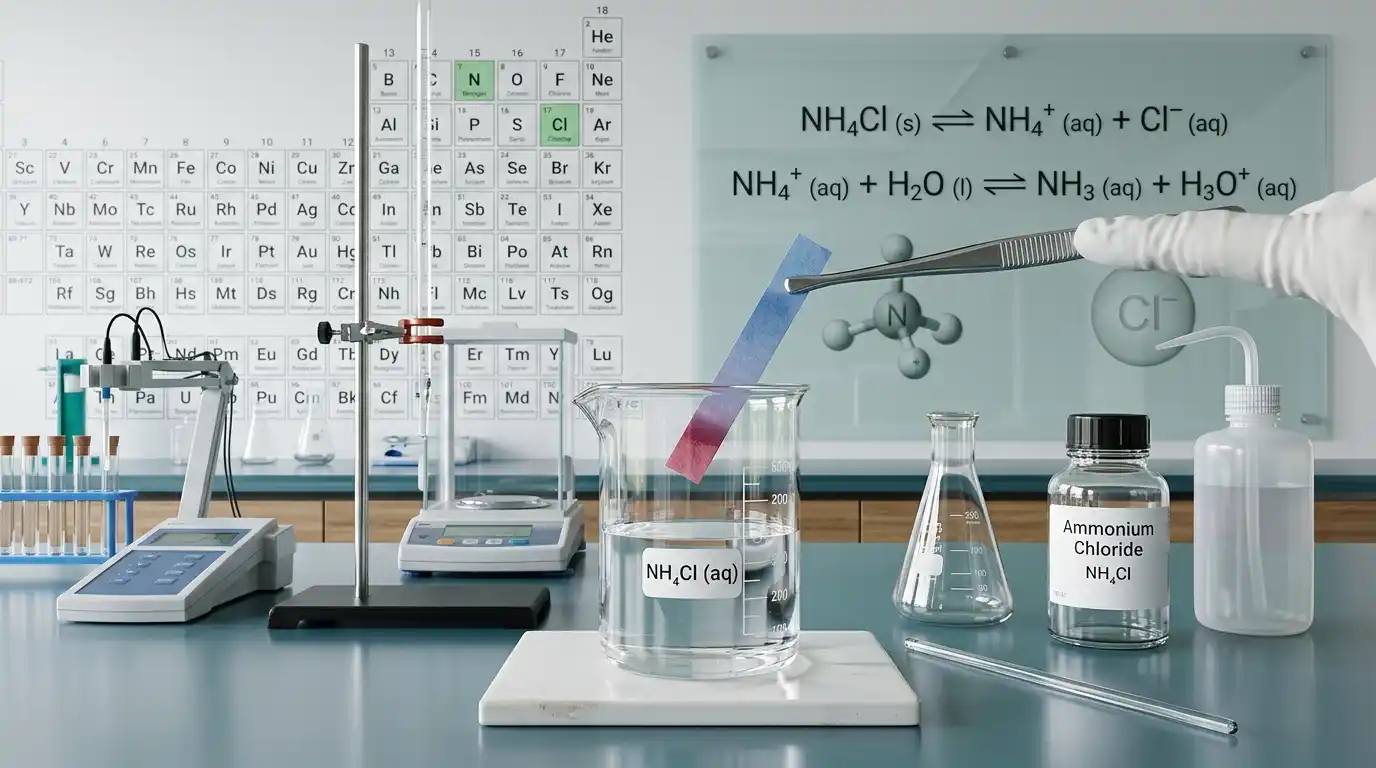
Ammonium chloride shows up in chemistry class, cough drops, and lab reports. But one question trips up almost every student: is NH4Cl acid or base? The short answer feels tricky because NH4Cl is a salt, not a simple acid or base. Yet it acts acidic in water. This mix confuses people fast.
People search “nh4cl acid or base” for a few reasons. “Some are studying for a chemistry test. Others are double-checking a lab result. Some just spotted the formula on a product label and wanted to understand it.”Whatever the reason, the confusion is the same: salts don’t fit neatly into “acid” or “base” boxes the way HCl or NaOH do.
This article gives you the quick answer first. Then it explains the chemistry behind it, so you understand why, not just what. You’ll also see common mistakes, real-world examples, and a comparison table showing how NH4Cl stacks up against other common salts. By the end, you’ll never second-guess this answer again.
NH4Cl Acid or Base Quick Answer
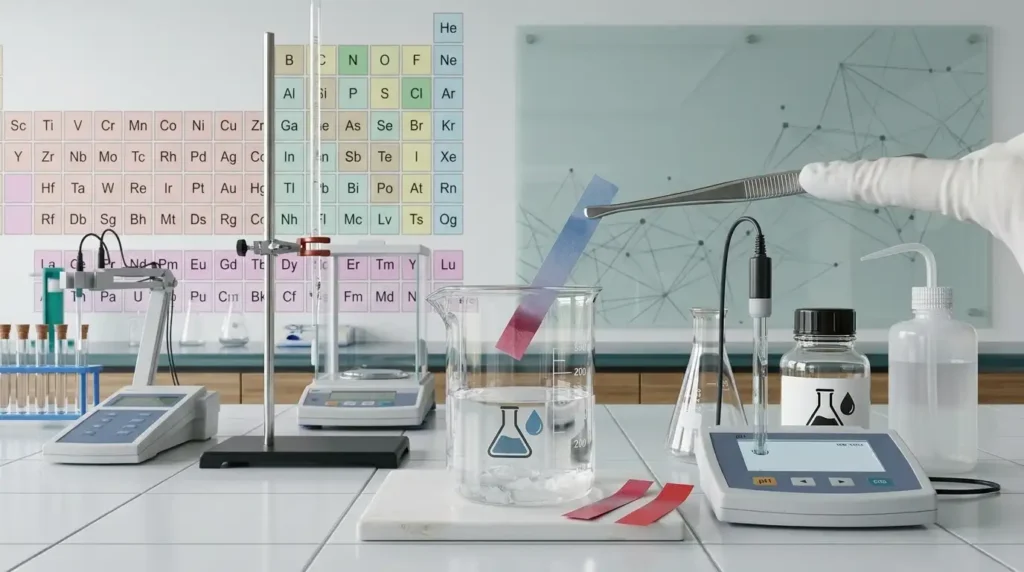
NH4Cl is an acidic salt. It forms from a strong acid (HCl) and a weak base (NH3, ammonia). When it dissolves in water, it makes the solution slightly acidic, with a pH usually between 4.5 and 5.5.
Here’s the simple version:
- NH4Cl itself is neither a pure acid nor a pure base. It’s a salt.
- In water, it releases NH4+ ions.
- NH4+ reacts with water and releases H+ ions.
- Extra H+ ions make the solution acidic.
Example: Dissolve NH4Cl in water, test it with litmus paper, and it turns blue litmus paper red. That confirms acidic behavior.
The Origin of NH4Cl
NH4Cl is the chemical formula for ammonium chloride. The name comes from two parts:
- Ammonium (NH4+), named after ammonia, which itself was named after the Egyptian god Ammon. Ancient traders collected ammonium chloride deposits near a temple dedicated to Ammon in Libya.
- Chloride (Cl-), from chlorine, discovered and named in the 1800s.
Chemists write it as NH4Cl because it shows one ammonium ion bonded with one chloride ion.
The “acid or base” confusion has a clear origin too. Early chemistry students learn that acids and bases are opposites. Then they meet salts, which come from combining an acid and a base. Naturally, people assume salts must be neutral. But that’s not always true. The strength of the original acid and base decides the final pH. This is where the mix-up starts.
Acidic Salts vs Basic Salts vs Neutral Salts
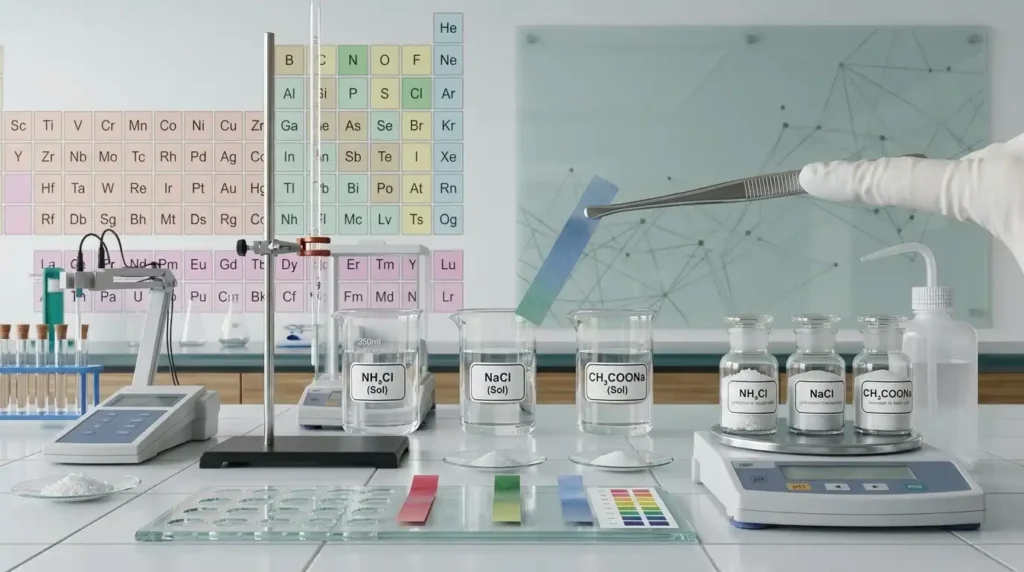
Instead of a spelling comparison, here’s the comparison that actually matters: how different salts behave in water, based on what acid and base made them.
| Salt | Formed From | Behavior in Water | pH Range |
| NH4Cl (ammonium chloride) | Strong acid (HCl) + Weak base (NH3) | Acidic | ~4.5–5.5 |
| NaCl (table salt) | Strong acid (HCl) + Strong base (NaOH) | Neutral | ~7 |
| CH3COONa (sodium acetate) | Weak acid (CH3COOH) + Strong base (NaOH) | Basic | ~8–9 |
| NH4CH3COO (ammonium acetate) | Weak acid + Weak base | Nearly neutral | ~7 |
The rule is simple: whichever partner is stronger wins the pH fight. In NH4Cl, HCl (strong acid) beats NH3 (weak base), so the result leans acidic.
Which Explanation Should You Use?
Your audience decides how deep to go.
Students taking a basic chemistry exam:
Say “NH4Cl is an acidic salt because it comes from a strong acid and a weak base.” That’s usually enough.
College-level or advanced chemistry:
Explain the hydrolysis reaction: NH4+ + H2O ⇌ NH3 + H3O+. This shows exactly why extra H+ ions form.
General readers or non-chemistry professionals:
Keep it practical: “NH4Cl solutions are mildly acidic, similar to black coffee.” That gives a real-world reference point.
Lab technicians or industry use:
Focus on measured pH values and how NH4Cl affects a solution’s overall acidity in a specific application, like soldering flux or fertilizer.
Common Mistakes with NH4Cl Acid or Base

- Calling NH4Cl a base because it contains “ammonium,” which people confuse with ammonia (a base). NH4+ is not the same as NH3.
- Assuming all salts are neutral. Only salts from a strong acid + strong base are neutral.
- Mixing up NH4Cl with NH4OH. NH4OH (ammonium hydroxide) is basic. NH4Cl is not.
- Skipping the hydrolysis step. Many learners memorize “acidic salt” without understanding the reaction that causes it.
- Ignoring concentration effects. A very dilute NH4Cl solution will have a pH closer to neutral than a concentrated one.
NH4Cl in Everyday Examples
Chemistry classroom email:
“Reminder: Thursday’s quiz will cover why NH4Cl behaves as an acidic salt. Make sure you can explain the hydrolysis reaction, not just the final answer.”
News article about fertilizers:
“Ammonium chloride, widely used as a nitrogen source in fertilizers, gradually lowers soil pH because of its mildly acidic behavior in water.”
Social media chemistry post:
“Quick chem fact: NH4Cl is acidic, not basic even though ‘ammonium’ sounds like ‘ammonia.’ Mix these up and you’ll lose points on the quiz 😬”
In a formal lab report:
“The measured pH of the 0.1 M NH4Cl solution was 5.13, consistent with its classification as an acidic salt.”
NH4Cl Acid or Base Search Trends & Usage Data
Search interest for “nh4cl acid or base” spikes during school terms, especially before chemistry exams in the US, India, Philippines, and the UK. It also gets steady searches from people checking product labels, since NH4Cl appears in cough syrups, batteries, and cleaning agents.
Related searches people also look up:
| Related Keyword | Search Intent |
| Is NH4Cl acidic or basic | Direct duplicate phrasing |
| NH4Cl pH value | Looking for exact numbers |
| Ammonium chloride hydrolysis | Deeper chemistry explanation |
| NH4Cl salt type | Classification question |
| Is ammonium chloride safe | Safety/product-related search |
| NH4Cl vs NaCl | Comparison-based search |
Most searchers want a fast, confident answer first. Detailed hydrolysis explanations get more attention from students in college-level courses.
FAQs
Is NH4Cl an acid, base, or salt?
It’s a salt. But it behaves as an acid when dissolved in water.
Why is NH4Cl acidic if it contains ammonia?
It contains ammonium (NH4+), not ammonia (NH3). NH4+ releases H+ ions in water, which makes the solution acidic.
What is the pH of NH4Cl solution?
Typically between 4.5 and 5.5, depending on concentration.
Is NH4Cl a strong or weak acid?
Neither. It’s not an acid on its own. It’s an acidic salt that produces mild acidity in solution.
Does NH4Cl turn litmus paper red or blue?
It turns blue litmus paper red, confirming its acidic nature.
Is NH4Cl safe to use at home?
Yes, in small amounts like in cough drops or cleaning products. Always follow product instructions.
What’s the difference between NH4Cl and NH4OH?
NH4Cl is an acidic salt. NH4OH (ammonium hydroxide) is a base. They are different compounds with opposite pH behavior.
Conclusion
NH4Cl is not a pure acid or a pure base. It’s a salt. But it acts acidic once dissolved in water, landing at a pH between 4.5 and 5.5. This happens because NH4Cl forms from a strong acid (HCl) and a weak base (NH3). The stronger partner controls the final result, and that’s why the solution turns acidic.
The confusion usually starts with the word “ammonium,” which sounds like “ammonia,” a known base. But NH4+ and NH3 behave differently in water. Once you separate these two ideas, the whole topic gets simple.
For students, memorize the short rule: strong acid + weak base = acidic salt. For professionals or curious readers, remember the practical comparison: NH4Cl solutions feel mildly acidic, similar to black coffee. And if you ever see NH4Cl on a label, in a report, or on an exam, you now know exactly how to explain it, correctly and with confidence.

“I’m Ibadat Fatima, a professional content writer and author with 3 years of experience in writing, editing, and storytelling. I share my work through visitlivo.com, where I help readers connect with clear, engaging, and well-crafted content.”