You’re writing a sentence. You need to show that something belongs to Jesus. Do you write “Jesus’ teachings” or “Jesus’s teachings”? You pause. Both look right. Both look wrong.
This is one of the most searched grammar questions online. People search for it because English possessive rules get tricky with names that end in “s.” Jesus is a name that ends in “s.” That’s where the confusion starts.
Writers, students, church newsletters, journalists, and content creators all hit this wall. Some style guides say one thing. Others say another. Even native English speakers argue about it.
This article gives you a clear answer. You’ll learn the quick rule, the history behind it, and how British and American English handle it differently. You’ll also see real examples and common mistakes to avoid.
By the end, you’ll never second-guess this spelling again.
Jesus or Jesus’s Quick Answer
Here’s the short version.
“Jesus'” is the traditional and most common form. Many style guides treat Jesus as a special case. They use just an apostrophe, with no extra “s.”
Example: Jesus’ disciples followed him.
“Jesus’s” is also correct in modern style guides, especially in American English. Some guides now prefer adding “‘s” to all singular nouns, even names ending in “s.”
Example: Jesus’s disciples followed him.
Both are accepted today. Your choice depends on which style guide you follow.
The Origin of Jesus or Jesus’s

The confusion goes back to old English grammar rules. Long ago, writers dropped the extra “s” after names ending in “s” for classical or biblical figures. This applied to names like Jesus, Moses, and Achilles.
The reasoning was about sound. Adding “‘s” to “Jesus” creates “Jesus’s,” which some people find awkward to say out loud. So writers simplified it to “Jesus’.”
Over time, general English grammar moved toward adding “‘s” to almost every singular noun, even ones ending in “s.” Think of names like “Chris’s book” or “James’s car.” But Jesus, along with a few other classical and religious names, kept its special treatment in many style guides.
This is why you still see both forms today. It’s not a mistake. It’s a tradition that hasn’t fully faded.
British English vs American English Spelling
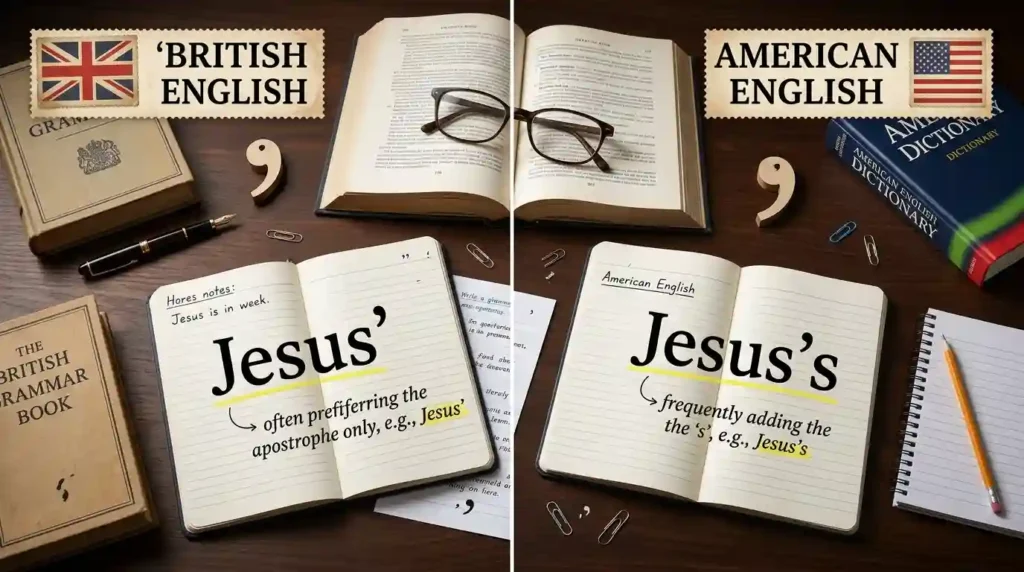
Spelling and grammar rules often split between British and American English. The Jesus possessive is one example.
British English tends to follow older, more traditional rules. Many British style guides, including some used by British newspapers, prefer “Jesus'” without the extra “s.”
American English has moved toward consistency. Modern American style guides, including The Associated Press Stylebook exceptions aside, often favor adding “‘s” to most singular nouns, including “Jesus’s.”
Religious texts and denominations also vary. Many Christian publications stick with “Jesus'” out of long-standing tradition, regardless of country.
| Style Guide | Preferred Form | Region |
| AP Stylebook | Jesus’ | American (with exceptions for classical/biblical names) |
| Chicago Manual of Style | Jesus’s | American |
| Oxford Style Guide | Jesus’ | British |
| Many church publications | Jesus’ | Global |
| Modern general writing | Jesus’s | American, informal |
Which Spelling Should You Use?
Your best choice depends on your audience and the style guide you follow.
If you’re writing for a US audience or business content, check which style guide your organization uses. The Chicago Manual of Style favors “Jesus’s.” AP style leans toward “Jesus'” for names like this.
If you’re writing for a UK or Commonwealth audience, “Jesus'” is the safer and more familiar choice. It matches traditional British usage.
If you’re writing for a global or religious audience, “Jesus'” is more common across denominations and translations of religious texts.
If you’re unsure, pick one form and stay consistent throughout your document. Consistency matters more than which form you choose.
Common Mistakes with Jesus or Jesus’s
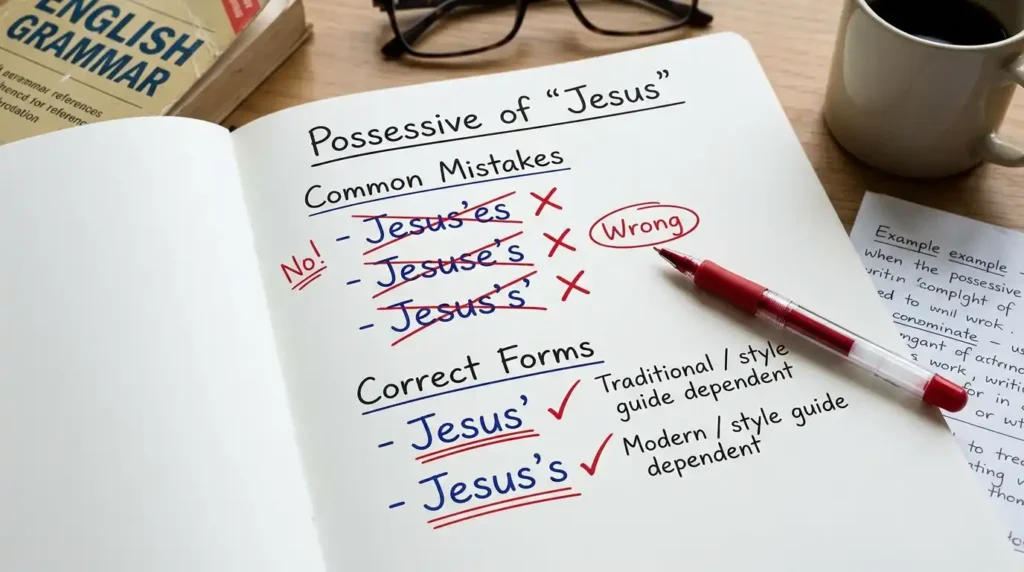
Here are frequent errors people make, and how to fix them.
Mistake 1: Mixing both forms in one document.
Wrong: Jesus’ love and Jesus’s grace.
Fix: Choose one form and use it every time.
Mistake 2: Adding an apostrophe without checking if it’s possessive.
Wrong: Jesus’s was born in Bethlehem. (This isn’t possessive at all.)
Fix: Only use an apostrophe when showing ownership. Jesus was born in Bethlehem.
Mistake 3: Treating “Jesus” like a regular plural noun.
Wrong: Jesuses’ teachings.
Fix: Jesus is a singular name. It doesn’t need pluralizing.
Mistake 4: Following the wrong style guide for your audience.
Fix: Match your spelling to your publication’s or region’s standard.
Jesus or Jesus’s in Everyday Examples

- Emails tend toward the traditional “Jesus'” because they’re informal, quick, and often mirror how people were taught in school.
- News writing frequently follows AP or a hybrid style, but many outlets have shifted to “Jesus’s” for consistency with their general possessive rules.
- Social media leans casual and traditional “Jesus'” reads more naturally in short, punchy text.
- Academic writing often follows Chicago Manual of Style, which favors “Jesus’s” for consistency across all singular nouns.
Notice how tone and publication type affect the choice. News and academic writing lean toward “Jesus’s.” Religious and social content often prefers “Jesus’.”
Jesus or Jesus’s Google Trends & Usage Data
Search interest for this question stays steady year-round, with small spikes around Christmas and Easter. This makes sense, since religious content and school assignments about Jesus increase during these seasons.
By country, searches for “Jesus'” tend to be higher in the UK, Australia, and other Commonwealth nations. Searches for “Jesus’s” show more strength in the United States, particularly in academic and journalistic contexts.
Context also shapes usage. Religious websites and sermons favor “Jesus’.” Secular news outlets and blogs show a more even split, with a slight lean toward “Jesus’s” in recent years as style guides shift.
Keyword Variations Comparison
| Variation | Common Usage | Example |
| Jesus’ | Traditional, religious, British | Jesus’ teachings |
| Jesus’s | Modern, American, academic | Jesus’s teachings |
| Jesus’s (rare) | Considered a typo | Not standard |
| Jesus’ or Jesus’s | Search term itself | Used when comparing both |
FAQs
Is “Jesus'” or “Jesus’s” grammatically correct?
Both are correct. It depends on the style guide you follow. Neither is a mistake.
Why does Jesus get special treatment in grammar rules?
Classical and biblical names ending in “s” often follow older grammar traditions that drop the extra “s” for smoother pronunciation.
Do British and American English really differ on this?
Yes. British English usually favors “Jesus’.” American English is more divided, with some guides preferring “Jesus’s.”
Which form do most churches use?
Most church publications and translations use “Jesus'” out of long-standing tradition.
Can I use “Jesus’s” in formal writing?
Yes, especially if you follow the Chicago Manual of Style or write for an American academic audience.
Is it wrong to switch between both forms?
Yes. Pick one form and use it consistently throughout your writing.
Does this rule apply to other names ending in “s”?
Yes. Names like Moses, Achilles, and Charles follow similar patterns, though modern style guides increasingly favor adding “‘s” to all of them.
Conclusion
The debate between “Jesus'” and “Jesus’s” comes down to tradition versus modern consistency. Both forms are grammatically accepted today. “Jesus'” follows older, classical rules often used in religious and British writing. “Jesus’s” reflects a more modern approach favored in American style guides like Chicago.
Your best move is simple: pick a style guide, choose one form, and stay consistent. If you write for a UK or religious audience, “Jesus'” is a safe, traditional choice. If you write for a US academic or general audience, “Jesus’s” works well too.
What matters most isn’t which form you pick. It’s consistency and confidence in your choice. Now that you understand the history and the rules behind both spellings, you can write without hesitation.
If you choose “Jesus'” or “Jesus’s,” you’re making a correct, defensible choice backed by real grammar traditions.

I’m Raheela Rani, a professional content writer and author with 3 years of experience in writing, editing, and storytelling. Through VisitLivo.com, I create clear, engaging, and well-crafted content that helps readers learn, connect, and communicate with confidence.