
Have you ever typed a word, stared at it, and thought, “Wait, is that spelled right?” You are not alone. Millions of people search for “is cancelled or canceled” every month. It looks like a simple word. But it has two correct spellings. That small fact confuses writers, students, and business owners alike.
The confusion is not your fault. English has two major forms: British English and American English. Each form follows its own spelling rules. This one word cancel becomes a perfect example of how the two systems differ.
In this article, you will get a quick answer first. Then we will explain the history behind the spelling split. You will see a clear comparison table, real-life examples, and expert tips on which spelling to use. By the end, you will never second-guess this word again.
Let’s clear up the confusion once and for all.
Is Cancelled or Canceled Quick Answer
Both spellings are correct. It depends on which English you use.
- Cancelled (two L’s) is the British English spelling.
- Canceled (one L) is the American English spelling.
Quick examples:
- 🇬🇧 British: “The flight was cancelled due to bad weather.”
- 🇺🇸 American: “The flight was canceled due to bad weather.”
Same meaning. Different spelling. Choose based on your audience or region.
The Origin of Cancelled or Canceled
The word cancel comes from the Latin word cancellare, meaning “to cross out” or “to make like a lattice.” It entered English through French in the 14th century.
For centuries, English spelling was not standardized. Writers spelled words however they liked. This changed in the 1700s and 1800s, when dictionaries began setting official rules.
The spelling split happened mainly because of one man: Noah Webster. In the early 1800s, Webster wrote an American dictionary. He wanted American English to look simpler and different from British English. He dropped extra letters from many words. This is why Americans write “color” instead of “colour,” and “canceled” instead of “cancelled.”
British English kept the older, more traditional spelling with double letters. That is why “cancelled” still uses two L’s today in the UK, Australia, Canada (partly), and other Commonwealth nations.
British English vs American English Spelling
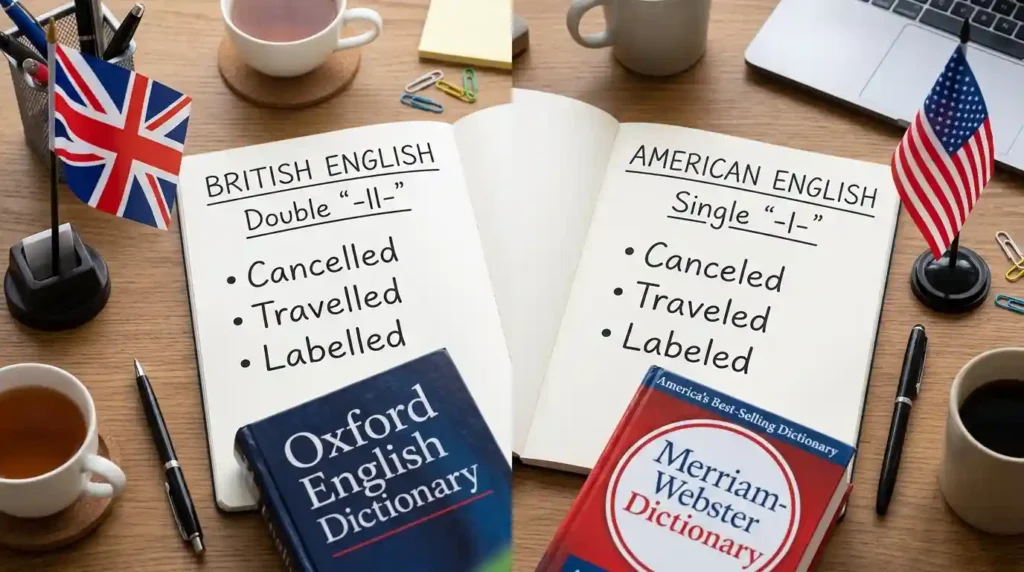
The rule behind this comes down to consonant doubling. British English tends to double the final consonant before adding “-ed” or “-ing,” even when the stress falls on the first syllable. American English usually keeps a single consonant in these cases.
Here are more examples that follow the same pattern:
| Word | British English | American English |
| Cancel | Cancelled | Canceled |
| Travel | Travelled | Traveled |
| Model | Modelled | Modeled |
| Label | Labelled | Labeled |
| Signal | Signalled | Signaled |
| Fuel | Fuelled | Fueled |
Notice the pattern? British English almost always doubles the “L.” American English keeps it single. This rule applies to many similar verbs, not just “cancel.”
Which Spelling Should You Use?
The right spelling depends on your audience.
Use “canceled” if:
- You are writing for a US audience.
- Your company is based in the United States.
- You are using American style guides (AP Style, Chicago Manual of Style).
Use “cancelled” if:
- You are writing for the UK, Ireland, Australia, or New Zealand.
- Your audience is in most Commonwealth countries.
- You follow British style guides (Oxford, Cambridge).
If your audience is global:
- Pick one spelling and stay consistent throughout your document.
- Check your brand or company style guide first.
- Note that “cancelled” is actually used more often worldwide, since more countries follow British English conventions.
For businesses, consistency matters more than which version you pick. Mixing both spellings in one document looks unprofessional.
Common Mistakes with Cancelled or Canceled

Even skilled writers slip up. Here are frequent errors:
- Mixing spellings in one document. ❌ “The event was cancelled, so we canceled the venue.” ✅ Pick one spelling and use it throughout.
- Misspelling the related noun. The noun form is cancellation in both British and American English. There is no American short version like “cancelation.” ❌ “Cancelation” ✅ “Cancellation”
- Wrong form for “-ing.”
- British: cancelling
- American: canceling ❌ “The meeting is canceling next week” (in British writing) ✅ “The meeting is cancelling next week”
- Assuming one spelling is “more correct.” Neither spelling is wrong. Context decides which one fits.
Cancelled or Canceled in Everyday Examples
In emails:
American: “Your subscription has been canceled as requested.”
British: “Your subscription has been cancelled as requested.”
In news headlines:
American: “Flight Canceled After Storm Warning Issued”
British: “Storm Warning Forces Flight Cancellation”
In everyday messages:
American: “Sorry, I have to cancel our meeting tomorrow.”
British: “Sorry, I have to cancel our meeting tomorrow.” (spelling only changes in the past tense or -ing form, not the base verb)
On social media: Both spellings trend depending on the platform’s audience. US-based apps and influencers often use “canceled,” while UK and Australian users write “cancelled.”
In formal business writing: Always match your spelling to your company’s primary market. A UK-based company writing to US clients may still use British spelling internally, but adjust for client-facing documents.
Cancelled or Canceled Google Trends & Usage Data

Search data shows a clear geographic pattern:
- “Canceled” is searched and used more in the United States.
- “Cancelled” is more common in the UK, Canada, Australia, India, and most other English-speaking countries.
Globally, “cancelled” often shows slightly higher search volume overall. This is because more countries default to British spelling conventions in education and media. However, “canceled” remains dominant in US-published content, given the size of the American publishing and media industry.
Context also affects usage. News outlets, airlines, and event organizers use these words constantly, especially during weather disruptions, flight delays, or event postponements. This keeps both terms consistently popular in search trends year-round.
Keyword Variations Comparison Table
| Variation | Spelling Style | Common Region |
| Cancelled | British | UK, Australia, Canada, India |
| Canceled | American | United States |
| Cancelling | British | UK, Australia |
| Canceling | American | United States |
| Cancellation | Universal | Both regions |
| Cancelations | Incorrect | Not standard usage |
Frequently Asked Questions
Is “cancelled” or “canceled” more correct?
Neither is more correct. “Cancelled” is British English, and “canceled” is American English. Both are grammatically correct in their respective regions.
Which spelling does the AP Style Guide use?
AP Style, used by most American journalists, recommends “canceled” with one L.
Which spelling does Oxford Dictionary use?
Oxford Dictionary lists “cancelled” as the primary British spelling, with double L’s.
Is “cancellation” spelled differently in American English?
No. “Cancellation” is spelled the same way in both American and British English, always with two L’s.
Can I use both spellings in the same document?
No. Mixing spellings looks inconsistent and unprofessional. Choose one style and use it throughout.
Why does American English use fewer letters?
Noah Webster simplified many English spellings in the 1800s to create a distinct American identity and make words easier to learn.
Does Canada use “cancelled” or “canceled”?
Canada often mixes both, but “cancelled” is more common, especially in formal and government writing.
Conclusion
The debate over “cancelled or canceled” comes down to one simple factor: which English you are writing in. British English uses “cancelled,” while American English uses “canceled.” Neither version is wrong. Both are accepted and widely used across the world.
If you’re writing for a US audience, choose “canceled.” If your readers are in the UK, Australia, or other Commonwealth countries, go with “cancelled.” For global audiences, consistency is what matters most. Pick a spelling and stick with it throughout your writing.
Remember, the noun form “cancellation” stays the same in both versions, so there is no need to overthink that one. Understanding this simple British vs. American spelling rule will help you write with confidence, If you’re drafting an email, a news article, or a business report.
Now you know exactly which spelling to use and why both are correct.

I’m Raheela Rani, a professional content writer and author with 3 years of experience in writing, editing, and storytelling. Through VisitLivo.com, I create clear, engaging, and well-crafted content that helps readers learn, connect, and communicate with confidence.