You have a chemistry quiz. Or homework. Or a lab report. And one question keeps showing up: is BCl3 polar or nonpolar?
Many students get stuck here. The reason is simple. BCl3 has polar bonds. But the whole molecule is not polar. That sounds odd. It seems like a trick, but it is not. The answer comes down to shape.
People search this keyword for a fast answer. They also want to know why. A teacher will not give full marks for one word. You need the reason too.
This article gives you both. You get the quick answer first. Then you get the steps. You will learn how electronegativity, shape, and dipoles work together. We also fix common mistakes and answer top student questions.
By the end, you will know that BCl3 is nonpolar. You will also know how to explain it in one clear sentence. You can use the same steps for other molecules too. Let’s start.
BCl3 Polar or Nonpolar? The Quick Answer
BCl3 is nonpolar.
BCl3 is boron trichloride. It has one boron atom and three chlorine atoms.
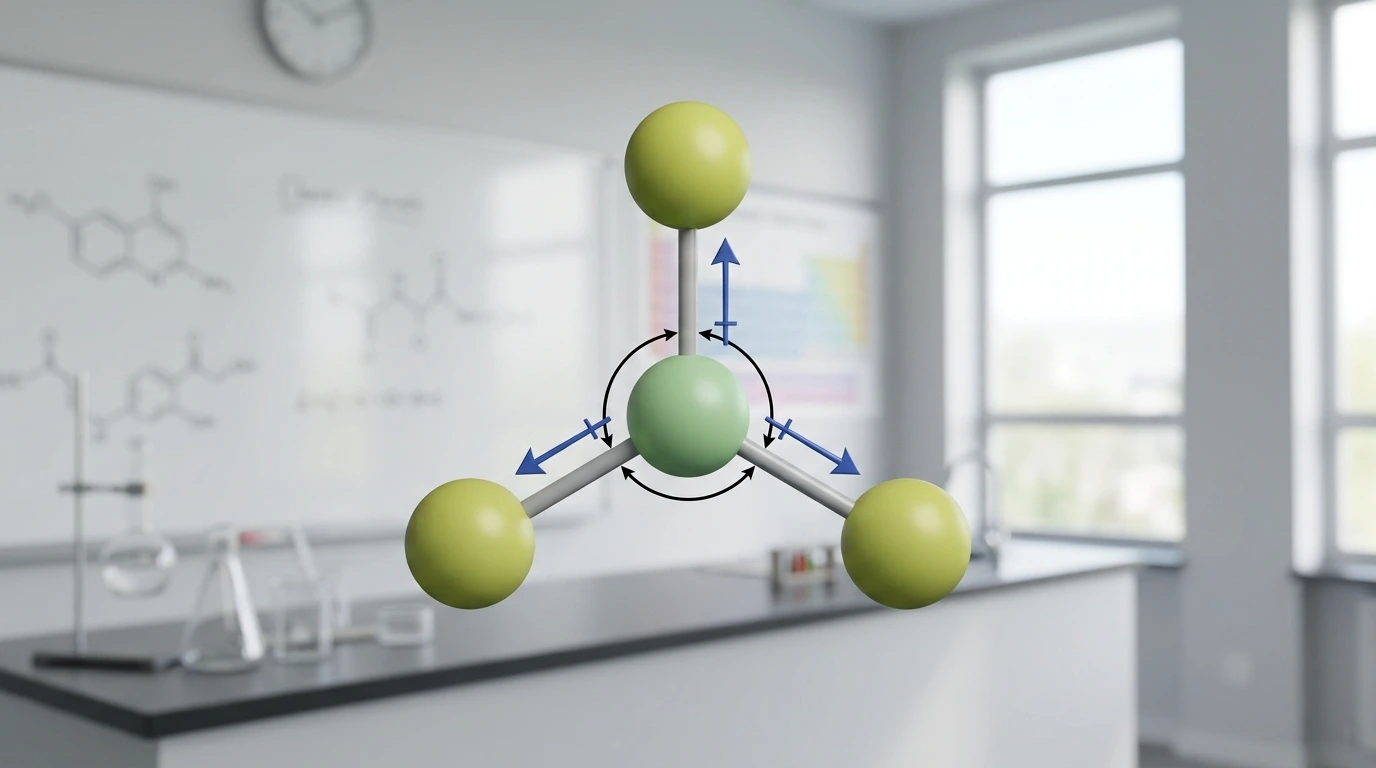
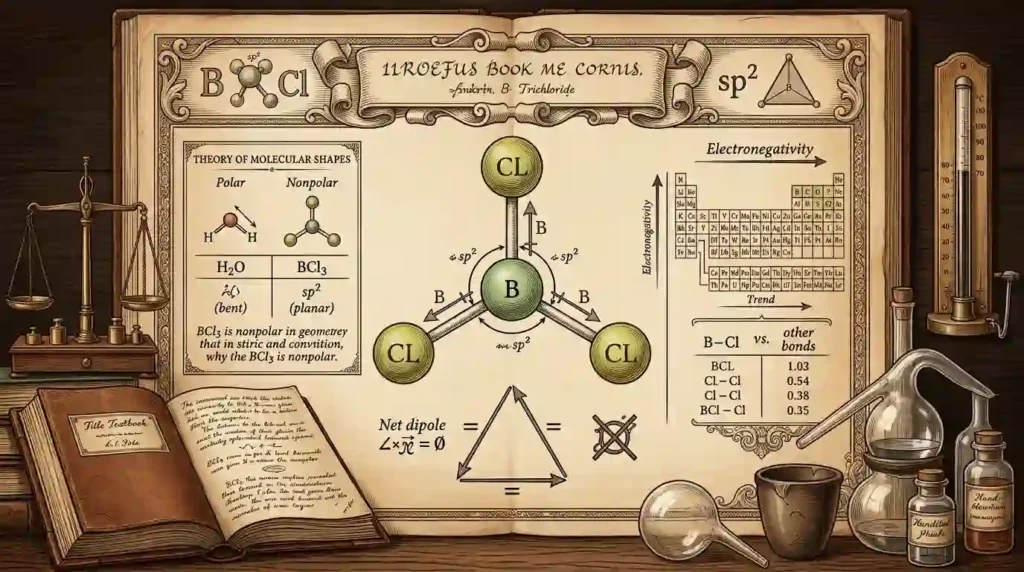
Each boron–chlorine bond is polar. Chlorine pulls electrons harder than boron does. But the three bonds sit evenly around boron, 120° apart, in a flat triangle. The three pulls are equal, so they cancel out. The molecule has no overall dipole.
Other nonpolar molecules with polar bonds:
- BF3: flat triangle, pulls cancel
- CO2: straight line, pulls cancel
- CH4: tetrahedral shape, pulls cancel
Polar molecules for contrast:
- NH3: pyramid shape, pulls do not cancel
- H2O: bent shape, pulls do not cancel
One-sentence answer for exams: “BCl3 is nonpolar because its trigonal planar shape is symmetric, so the bond dipoles cancel.”
The Origin of BCl3 Polar or Nonpolar
The question makes more sense when you know where the ideas came from.
The name. Boron comes from the word borax. Borax is an old mineral known for centuries. Chemists first isolated boron in 1808. “Trichloride” means three chlorine atoms.
The polarity idea. In 1932, Linus Pauling made the electronegativity scale. It tells us how hard an atom pulls on shared electrons. Peter Debye studied dipole moments, which measure how uneven a molecule’s charge is. He won a Nobel Prize in Chemistry in 1936.
The shape idea. In the 1950s, chemists built VSEPR theory. It says electron groups push away from each other. In BCl3, three groups push apart as far as they can. That gives a flat triangle.
Why the confusion exists. Students learn “polar bond” first. Then they learn “polar molecule.” The two are not the same. A molecule can have polar bonds and still be nonpolar. That is exactly what happens in BCl3.
A small spelling note. Some people write “nonpolar.” Others write “non-polar.” Both mean the same thing. More on that below.
Bond Polarity vs Molecular Polarity (and Spelling Differences)
Your template asked for British vs American spelling. For this keyword, the bigger split is between bond polarity and molecular polarity. Spelling is a small extra.
The spelling side:
- Nonpolar is the common form in the US.
- Non-polar is common in the UK and many Commonwealth countries.
- “BCl3” and “boron trichloride” are spelled the same everywhere. The formula is the same worldwide.
The concept side:
| Feature | Bond Polarity | Molecular Polarity |
| What it looks at | One bond between two atoms | The whole molecule |
| What causes it | Electronegativity difference | Bond polarity plus shape |
| BCl3 result | Polar (B–Cl) | Nonpolar |
| Key number | Difference of about 1.12 (3.16 − 2.04) | Dipole moment of zero |
| Can shape cancel it? | No | Yes |
Quick steps to check any molecule:
- Draw the Lewis structure.
- Find the shape with VSEPR.
- Check if the bonds are polar.
- Ask: do the pulls cancel?
Applied to BCl3:
- Boron has 3 outer electrons. It bonds with three chlorine atoms. It has no lone pairs.
- Three electron groups make a trigonal planar shape. The angle is 120°.
- Each B–Cl bond is polar.
- The three equal pulls cancel. Result: nonpolar.
Which Spelling Should You Use?
Use the form that fits your reader.
- US students and writers: Use “nonpolar.”
- UK, India, Pakistan, and other Commonwealth readers: “Non-polar” is common, and “nonpolar” is fine too.
- Global or scientific writing: Follow the journal or school style guide. If there is none, pick one form and stay with it.
Professional advice:
- Never mix “nonpolar” and “non-polar” in the same paper.
- Write the formula as BCl₃ with a subscript when you can. Use BCl3 in plain text.
- Always give the reason, not just the answer.
Common Mistakes with BCl3 Polar or Nonpolar
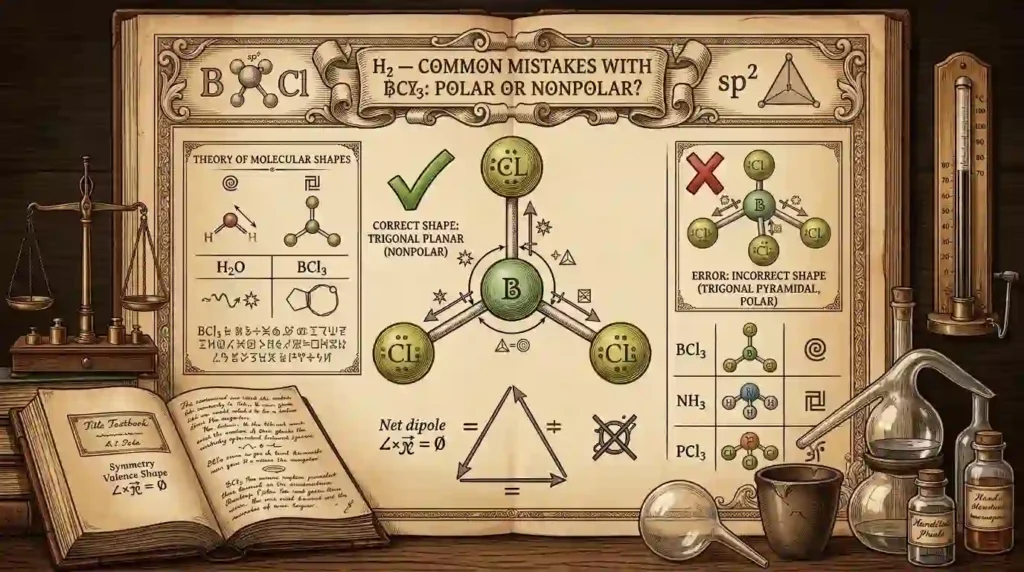
| Mistake | Correction |
| “B–Cl bonds are polar, so BCl3 is polar.” | Bond polarity is not molecule polarity. Check the shape. |
| “BCl3 is pyramid-shaped like NH3.” | NH3 has a lone pair. BCl3 has none. BCl3 is flat. |
| “Boron has an incomplete octet, so it is polar.” | Electron count does not decide polarity. Symmetry does. |
| “Nonpolar means no polar bonds.” | Nonpolar molecules can have polar bonds. |
| “The dipole moment of BCl3 is small.” | It is zero. |
| Mixing up BCl3 with PCl3. | PCl3 has a lone pair, is pyramidal, and is polar. |
BCl3 Polar or Nonpolar in Everyday Examples
Exam answer:
“BCl3 is nonpolar. It is trigonal planar, and the three B–Cl dipoles cancel.”
Email to a teacher:
“Hello, I have a question about BCl3. I know the bonds are polar. Why is the molecule nonpolar? Is it because of the flat shape?”
News or science blog:
“Boron trichloride is a nonpolar molecule. It is used to make other boron compounds and in the chip industry.”
Social media or study group:
“Quick tip: BCl3 is nonpolar. Polar bonds, but a symmetric shape. The dipoles cancel.”
Formal lab report:
“The dipole moment of boron trichloride is zero, consistent with its trigonal planar geometry.”
BCl3 Polar or Nonpolar Google Trends and Usage Data
I can’t pull live Google Trends numbers here, so I won’t make any up. Here is what usually holds for chemistry homework keywords like this one:
- Timing: Interest tends to rise during school terms and exam seasons. It tends to dip in holidays.
- Where: Countries with many English-speaking chemistry students, such as the US, India, Pakistan, the UK, and the Philippines, are typical sources of this kind of search.
- Context: Most searchers are students who want a fast answer with a reason. Some are teachers making notes.
- Best check: Open Google Trends, enter your keyword, and filter by country and date range. Compare it with related searches.
Keyword variations side by side:
| Search Phrase | Likely Intent |
| bcl3 polar or nonpolar | Quick answer plus reason |
| is bcl3 polar | Yes/no check |
| is bcl3 nonpolar | Confirming the answer |
| boron trichloride polar or nonpolar | Full-name search, often formal |
| bcl3 non-polar | UK-style spelling |
| bcl3 dipole moment | Deeper, more technical |
| bcl3 molecular geometry | Shape and structure |
FAQs
Is BCl3 polar or nonpolar?
It is nonpolar. The flat, symmetric shape cancels the bond dipoles.
Are the B–Cl bonds polar?
Yes. Chlorine is more electronegative than boron, so each bond is polar.
What is the shape of BCl3?
Trigonal planar, with 120° bond angles.
What is the dipole moment of BCl3?
Zero.
Why is BCl3 nonpolar if its bonds are polar?
The three bond pulls are equal and point in balanced directions. They cancel.
Is BCl3 polar like NH3?
No. NH3 has a lone pair and a pyramid shape, so it is polar. BCl3 has no lone pair and is flat.
Is BCl3 soluble in water?
It reacts with water instead of simply dissolving. It makes boric acid and hydrochloric acid. So do not judge it by “like dissolves like” alone.
Conclusion
So, is BCl3 polar or nonpolar? It is nonpolar.
Here is the key idea. Bonds can be polar. Molecules can still be nonpolar. Shape decides the final result. In BCl3, three equal B–Cl bonds sit in a flat triangle. The pulls cancel. The dipole moment is zero.
Remember the four steps. Draw the Lewis structure. Find the shape. Check the bonds. See if the pulls cancel. These steps work for many other molecules too. Try them on BF3, CO2, CH4, and NH3.
For writing, keep it simple. Use “nonpolar” for US readers. Use “non-polar” if your audience or style guide prefers it. Never mix the two in one piece.
In an exam, do not stop at one word. Say the answer, then say why. A good sentence is: “BCl3 is nonpolar because its trigonal planar shape is symmetric, so the bond dipoles cancel.”
Now you have the quick answer and the full reason. Use both with confidence.

“I’m Ibadat Fatima, a professional content writer and author with 3 years of experience in writing, editing, and storytelling. I share my work through visitlivo.com, where I help readers connect with clear, engaging, and well-crafted content.”